


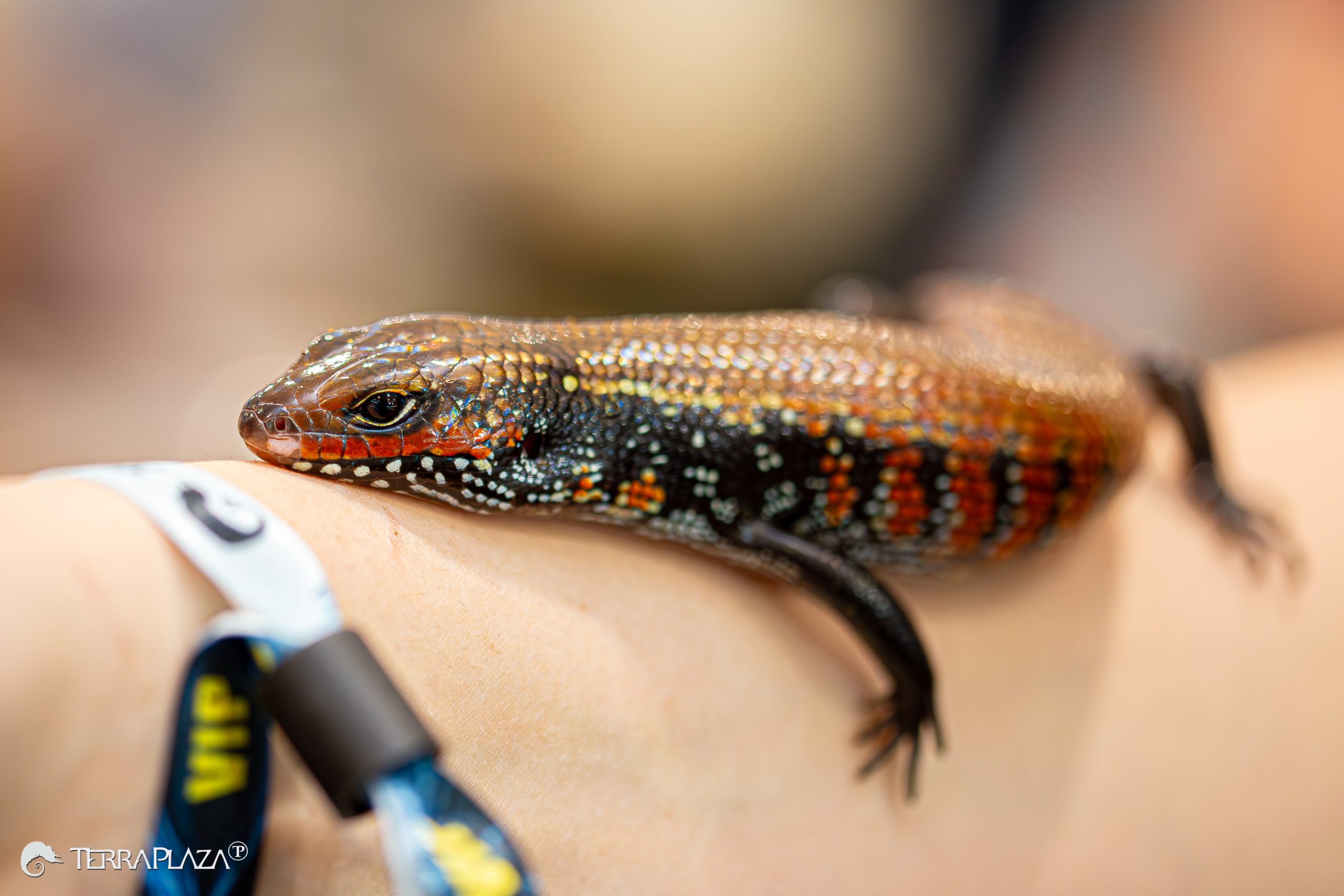
The fire skink, scientifically known as Mochlus fernandi, is one of the most striking members of the skink family. Its name is no coincidence: the vivid red, black, silver and golden patterning on its body truly resembles flickering flames.
The species is native to the tropical, humid forests of West and Central Africa. In its natural habitat, it spends much of its time on the forest floor, moving among leaf litter, loose soil and natural hiding places. Although it is a diurnal species, the fire skink is generally shy and secretive. In captivity, under suitable conditions, it may gradually become calmer and more accustomed to its keeper, but it is not considered a highly social or frequently handled reptile.
Appearance
The fire skink can reach a total length of up to 35–38 centimetres, including the tail. Its most distinctive feature is its exceptionally vivid coloration. Smooth, golden-toned scales cover the back, while the sides are decorated with red and black bars set against a silvery background. This striking contrast is one of the main reasons why the species is especially popular among reptile keepers.
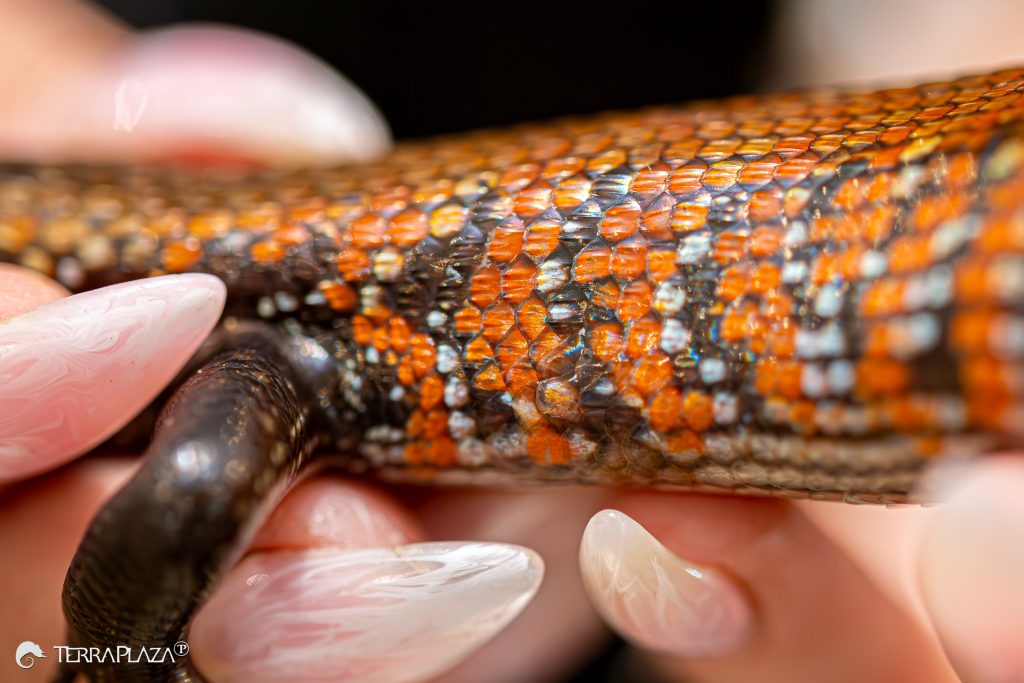
Photo: Borbála Sütő-Nagy
Sexing fire skinks is not always easy, as the species does not show obvious sexual dimorphism. Males are usually somewhat more robust, with a slightly flatter head and broader jaws, but these differences are not always clearly visible.
Distribution and Taxonomy
Mochlus fernandi prefers humid, forested habitats. Its range extends across the moist forest zones of southwestern West Africa and Central Africa, from Guinea and Sierra Leone to Gabon and the Democratic Republic of the Congo.
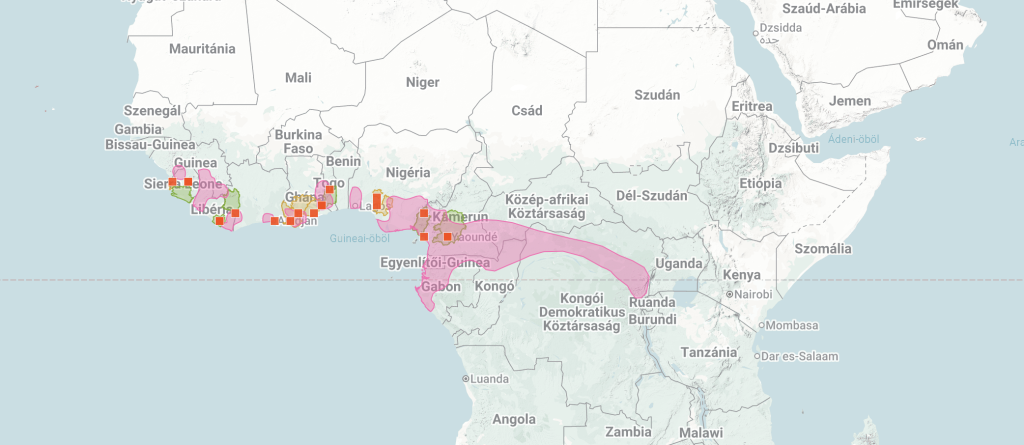
Source: iNaturalist
The taxonomic classification of the species has changed several times over the years. It was previously placed in other genera and was for a long time classified in the genus Riopa alongside several Southeast Asian skinks. Later research, however, showed that the African fire skink is not closely related to those Asian species, and it is now placed in the genus Mochlus.
In the past, several similar-looking populations were treated under the name fire skink as a single species. Taxonomic revisions have since shown that what was once considered one species actually consists of several separate species. As a result, the true Mochlus fernandi is mainly restricted to tropical West Africa and the western part of Central Africa.
Lifestyle
The fire skink is active during the day, but it is not always easy to spot. It often burrows into loose substrate or hides among leaf litter, roots and other natural shelters. This behaviour is also commonly observed in captivity, which is why a suitable burrowing substrate and plenty of hiding places are especially important when keeping the species. With proper care, fire skinks can live for 15–20 years.
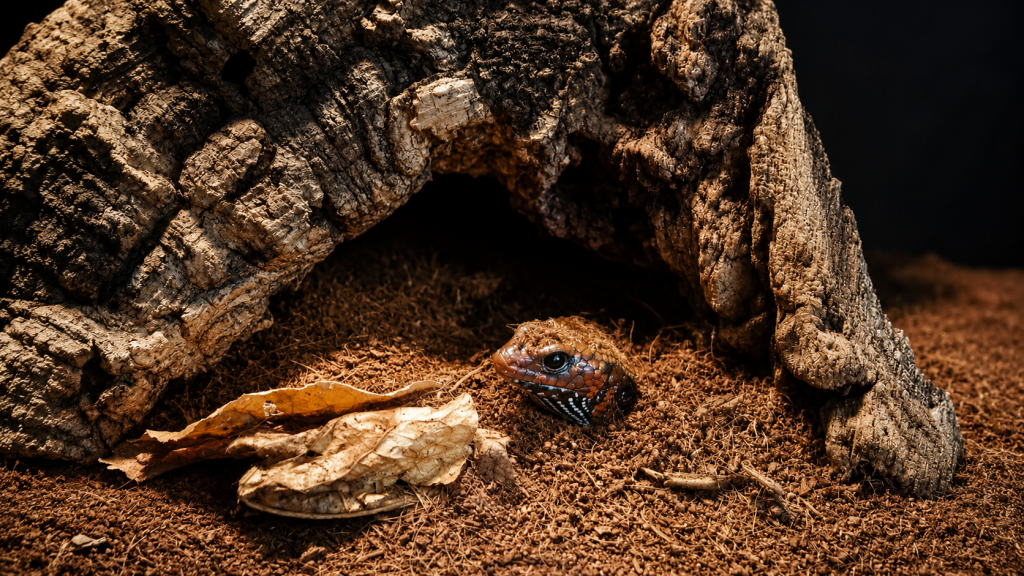
Photo: Vivien M. Farkas
Feeding
The fire skink is primarily insectivorous. In captivity, it can be fed mainly with crickets, larvae and other appropriately sized feeder insects. It is known to have a good appetite, so its diet should be made up of a variety of insect species and, when necessary, supplemented with vitamins and minerals to support healthy development and long-term condition.
Fire skinks are often active and curious during feeding, making food offering a useful way to build trust. With patience and regular tong-feeding, many individuals gradually become accustomed to their keeper and may become calmer around human presence and handling.
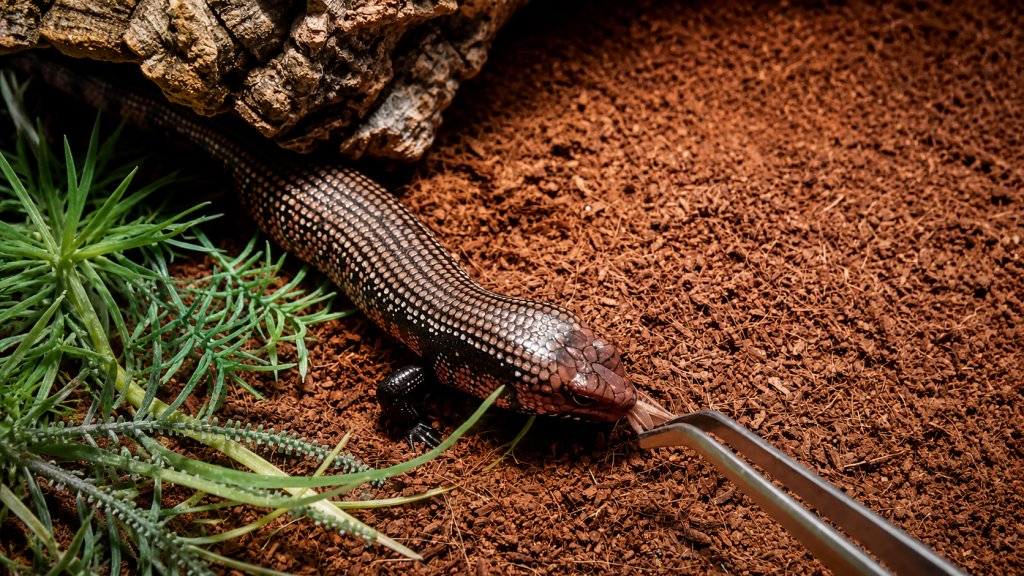
Photo: Vivien M. Farkas
Keeping Fire Skinks in a Terrarium
The fire skink is a popular terrarium animal, but it requires a carefully planned environment. Since it is primarily ground-dwelling, floor space is especially important. For one adult individual, a terrarium with a floor area of around 80 × 50 cm can be considered a suitable starting size. Although it may occasionally climb, the setup should focus mainly on horizontal space, deep substrate and hiding places.
A loose, diggable substrate should be used in the terrarium, as it allows the animal to display natural behaviour. The environment should be humid and slightly moist, with plenty of ground cover, leaves, bark pieces and shelters. One side of the terrarium should be warmed with a basking lamp, allowing the skink to choose the temperature that suits it best.
It is important to note that some fire skinks available in the pet trade are wild-caught, although captive-bred individuals are also available. Responsible buyers should always prioritise animals from reliable sources, especially captive-bred specimens whenever possible.
Summary
With its extraordinary coloration, the fire skink immediately attracts attention, but its value goes beyond its appearance. It is an interesting, secretive, ground-dwelling lizard that can live for many years, even 15–20 years, when kept under suitable conditions. Its care, however, requires responsibility: it needs a humid terrarium rich in hiding places, a substrate suitable for burrowing, appropriate temperatures and a varied insect-based diet.
For keepers who understand that this species is better suited for observation than frequent handling, the fire skink can be a truly special and impressive terrarium inhabitant.
