




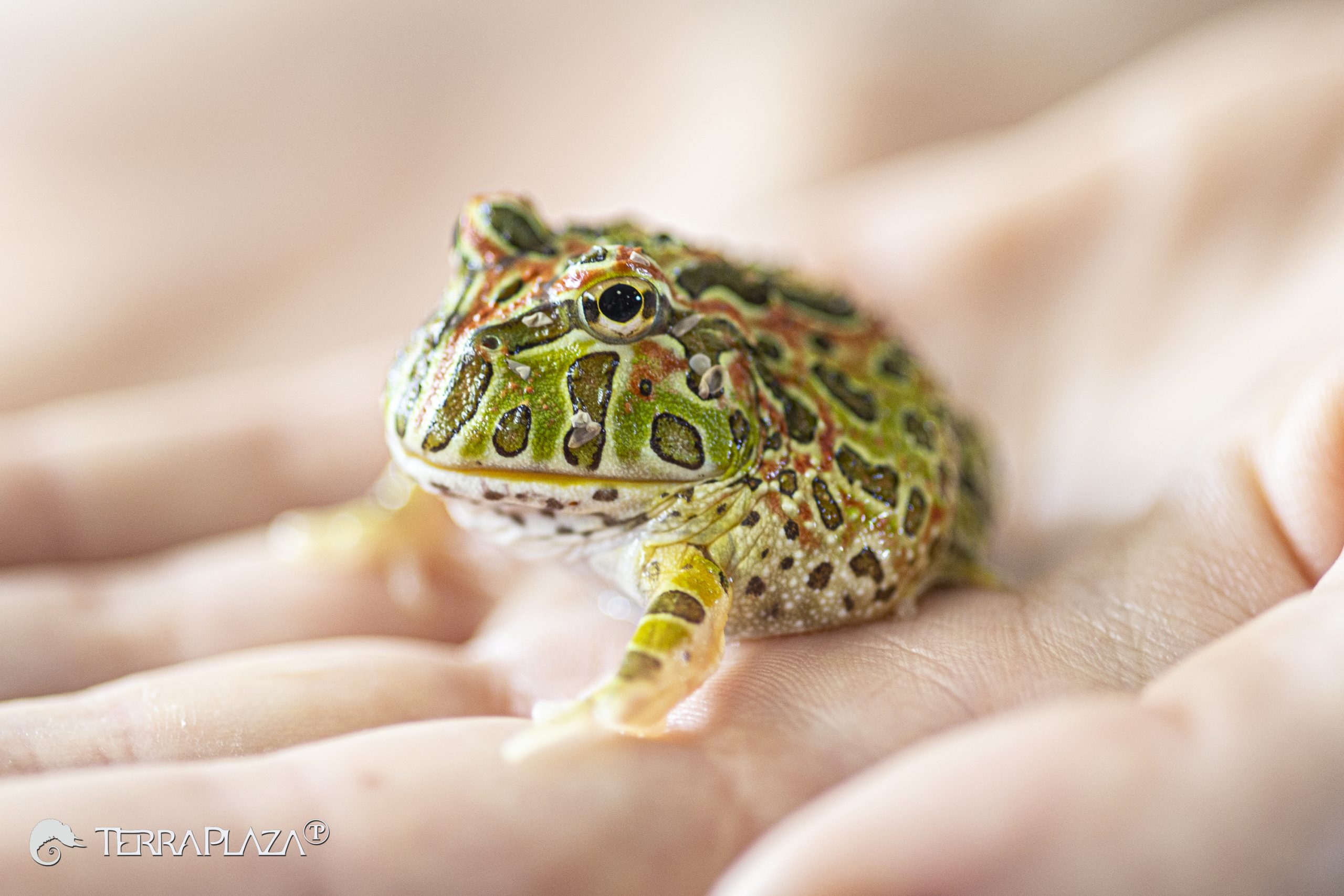
Stocky bodies, striking patterns, and an enormous mouth – Pacman frogs are remarkable creatures even at first glance. Their common name refers to their rounded appearance, reminiscent of the voracious character from the classic video game. Behind their eye‑catching looks, however, lie patient ambush predators: they remain motionless for long periods, waiting for prey to come within reach, then strike with lightning speed.
In the pet trade, Ceratophrys cranwelli and Ceratophrys ornata are the most widespread species, along with various captive‑bred morphs and hybrids. Therefore, this article focuses primarily on these forms.
Pacman frog: Ceratophrys ornata or cranwelli?
The name “Pacman frog” does not refer to a single species.
In terrarium keeping, several similar Ceratophrys species are commonly referred to by this name, including Ceratophrys ornata and Ceratophrys cranwelli. Their shared traits – a stocky body, an extremely wide mouth, and an ambush‑based hunting strategy – make them easy to confuse at first glance.
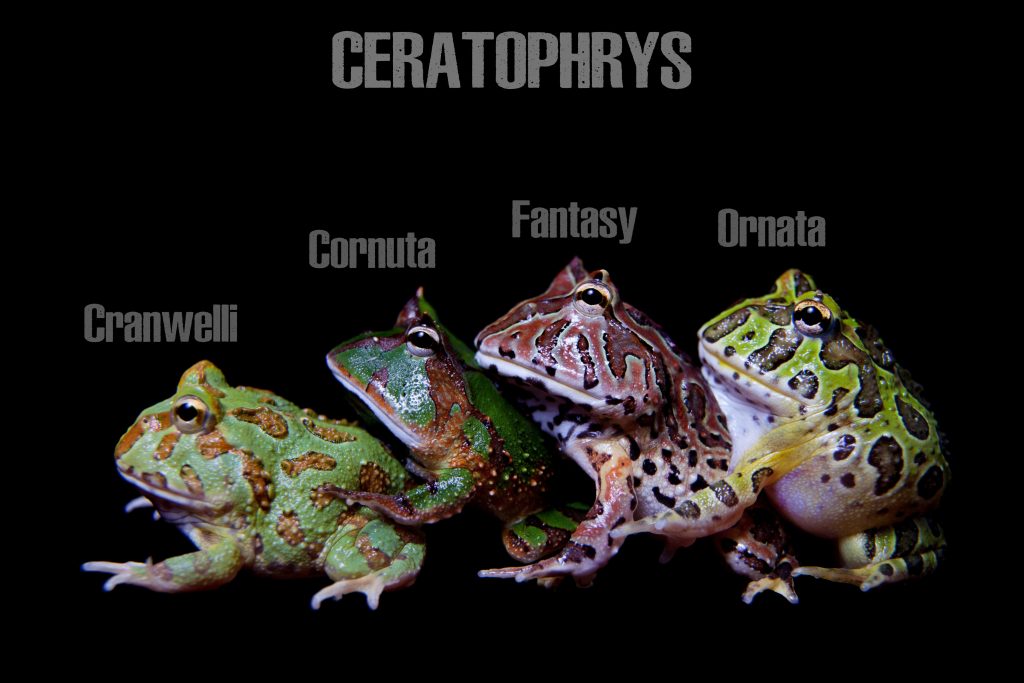
A wide range of colour and pattern morphs, as well as hybrids, can be found in the trade. As a result, the term “Pacman frog” does not necessarily identify the exact species or variety. The different Ceratophrys species share many aspects of their lifestyle and basic husbandry requirements, yet they may differ in size, natural distribution, and appearance.
From the Pampas to the Gran Chaco
Ceratophrys species are native to South America, but their natural distribution and habitats differ between species. The ornate horned frog (Ceratophrys ornata) occurs primarily in the pampas region of Argentina, and is also known from coastal areas of Uruguay and the southernmost parts of Brazil. In contrast, Ceratophrys cranwelli inhabits the Gran Chaco region, with a range extending across Argentina, Bolivia, Brazil, and Paraguay.
Horned frogs commonly kept in terrariums generally exhibit a strongly terrestrial lifestyle: they spend most of their time on the ground surface or partially buried in the substrate.
Their activity can be strongly influenced by changes in rainfall and humidity; they may become more active during wetter periods, while in drier conditions they often retreat into the soil.
Survivors of the dry season
One of the most remarkable adaptations of horned frogs is aestivation. During this dormant state, they can endure dry, unfavourable periods. As conditions become arid, they burrow into the soil, their activity decreases significantly, and they may remain hidden for extended periods.
During this subterranean resting phase, the outer layers of their skin dry out and form a protective cocoon around the body. This reduces evaporation and helps minimise water loss throughout the dry season.
When rainfall and humidity increase again, the frogs emerge from the soil, shed the protective layer, and return to their usual way of life. In addition, the breeding season is closely tied to periods of heavier rainfall, which often coincide with increased movement and mate-seeking behaviour.
Colours, patterns, and sexual differences
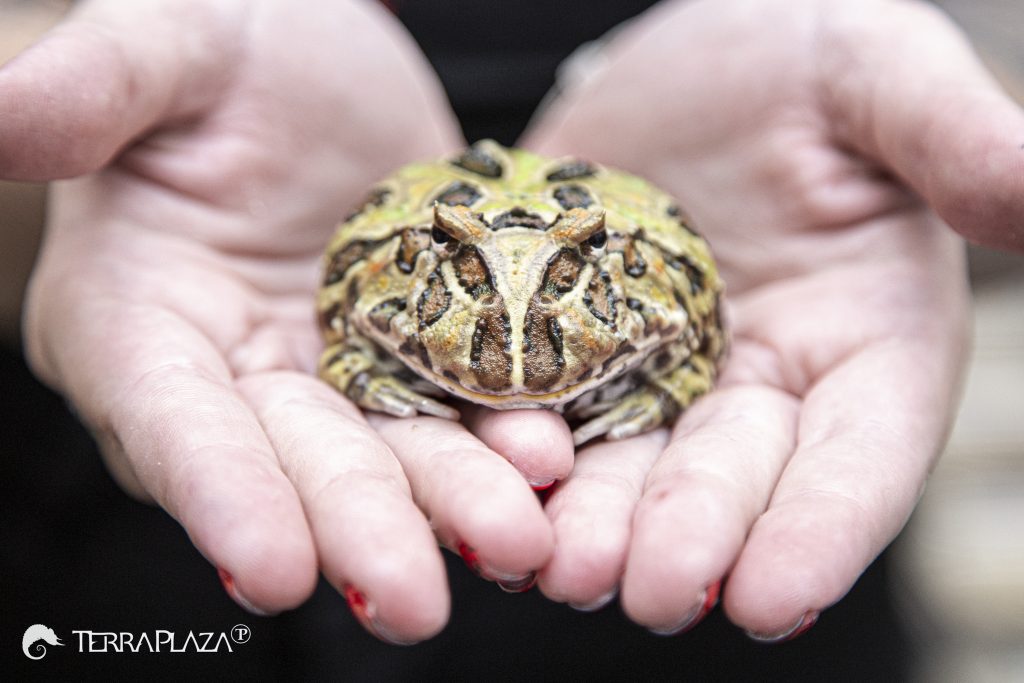
Horned frogs are characterised by a stocky, broad body, a large head, and an exceptionally wide mouth. Their eyes are positioned on top of the head. Above them are horn-like skin projections whose size and shape vary between species, giving rise to the name “horned frog”.
Their natural coloration varies both between species and among individuals: green, brownish, or yellowish base colours are typically overlaid with darker blotches and irregular patterns that aid in camouflage.
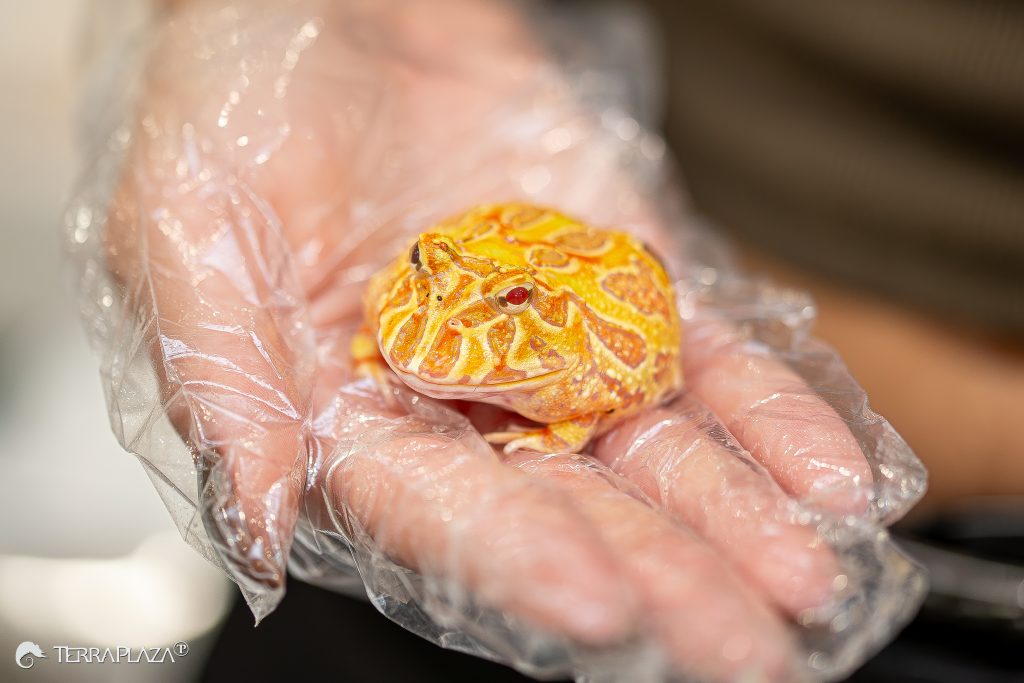
In terrarium keeping, however, selective breeding has produced a wide array of striking colour and pattern morphs. Ceratophrys cranwelli, in particular, occurs in numerous colour morphs. These include Albino, Strawberry, Strawberry Pineapple, Apricot, Peppermint, Coffee, Matcha, Pikachu and Samurai. By comparison, the High Red Ornate morph is well known among captive-bred C. ornata. It stands out for its intense red colouration.
Fantasy frogs represent a distinct category: they are not separate species or simple colour morphs, but hybrids created by crossing Ceratophrys cranwelli with Ceratophrys cornuta. Their appearance shows recognisable traits of both parent species, and these hybrids also occur in several colour variations.
There can be a pronounced size difference between the sexes: females typically grow much larger than males. Depending on the species, females may reach a body length of roughly 10–18 centimetres, while males usually attain around 6–10 centimetres. Mature males may develop nuptial pads on their forelimbs, and they are the ones that produce the mating call heard during the breeding season.
Motionless ambush predator
Horned frogs are classic ambush predators. They spend most of their time motionless, often partially buried in soil or leaf litter, with only their head and eyes exposed. Their camouflage allows them to blend into their surroundings, enabling them to wait unnoticed until prey comes within striking distance. Then, when the moment is right, they attack with surprising speed. They seize the prey with their wide mouths, while their strong jaws help hold it firmly in place.
Their diet is extremely varied. They often strike at prey that appears surprisingly large compared with their own body size. Their natural diet includes insects and other invertebrates, as well as small amphibians, reptiles and mammals.
They will attempt to consume almost anything that comes close enough and fits into their mouth.
In terrariums, their diet should consist mainly of a variety of appropriately sized invertebrates. Suitable foods include crickets, locusts, cockroaches, earthworms and insect larvae. Larger individuals may occasionally eat small vertebrate prey; however, this should not form a regular part of their diet.
Overly rich and excessive feeding can easily lead to obesity and health problems.
Setting up the proper terrarium
Ornate horned frogs do not require a tall enclosure because they spend most of their time at ground level. They are often partially buried in the substrate. For an adult, a terrarium of approximately 40 × 40 × 30 centimetres is a suitable starting point. In addition, individuals should be housed separately, as these voracious predators may view a conspecific as potential prey.
The substrate should be at least 8–10 centimetres deep, capable of retaining moisture while remaining loose enough for burrowing. A natural soil mix or a coconut‑fiber–based medium works well, and it can be supplemented with leaf litter and moss. The lower layers should remain slightly moist, but the substrate must not be persistently waterlogged.
Proper ventilation is just as important as humidity, since stagnant, overly wet conditions can quickly lead to hygiene issues.
During the day, a baseline temperature of 24–27 °C is appropriate. However, one area should be slightly warmer, at around 28–29 °C. At night, temperatures may drop to 18–22 °C. Prolonged exposure to temperatures above 30 °C should be avoided. Humidity can generally be maintained between 60 and 80%. However, the substrate should not remain continuously saturated with water.
The terrarium should always include a shallow, easily accessible water dish that the frog can sit in and climb out of without difficulty. The water must be changed regularly. In addition, use dechlorinated water, as amphibians can easily absorb chemicals through their permeable skin.
They do not require strong lighting. However, providing a natural day–night cycle is beneficial. Low‑intensity UVB lighting can be advantageous, provided that shaded and fully covered areas are available for the animal. The terrarium may be furnished with plants, leaf litter, and other natural elements, but sufficient loose substrate must always remain available for burrowing.
Better suited for observation
Horned frogs are not among the types of pets that tolerate or benefit from regular handling.
Their skin is thin and highly permeable, making it vulnerable to salts, cosmetics, chemical residues, and other contaminants that may be present on human hands.
Unnecessary contact is therefore best avoided. If the frog must be picked up or moved, this should be done with moistened, powder‑free gloves.
Proper hygiene within the terrarium is equally important. In addition, contaminated substrate and water can promote skin problems, while accumulated waste may threaten the frog’s health.Bacterial and fungal infections of the skin and eyes are common issues in amphibians, and various parasitic infections may also occur. Poor hygiene, dirty water or substrate, and unsuitable husbandry conditions increase these risks.
A newly acquired frog may temporarily lose its appetite due to the stress of transport and the unfamiliar environment. In such cases, it is advisable to provide a few days of quiet, then offer food again. Persistent loss of appetite, however, is a sign that warrants attention.
Despite their deceptively calm appearance, they can defend themselves: their strong jaws are capable of delivering a painful bite. For this reason as well, horned frogs are far better suited for observation than for frequent handling.
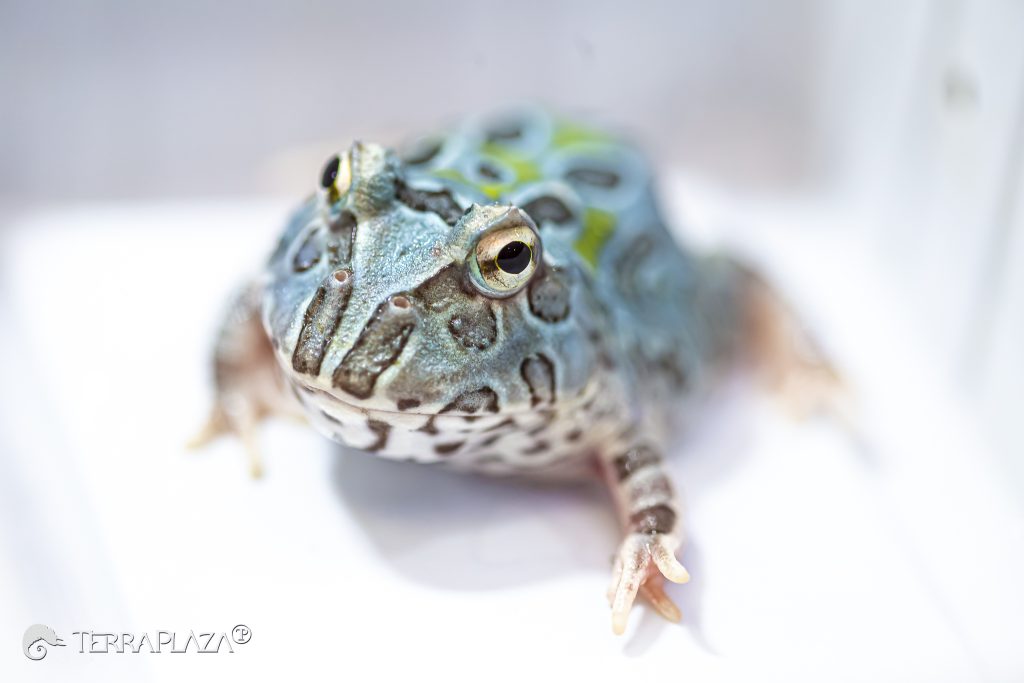
Horned frogs can live for more than ten years when kept under proper conditions. Their distinctive appearance and fascinating behaviour make them engaging terrarium animals for many years.
