




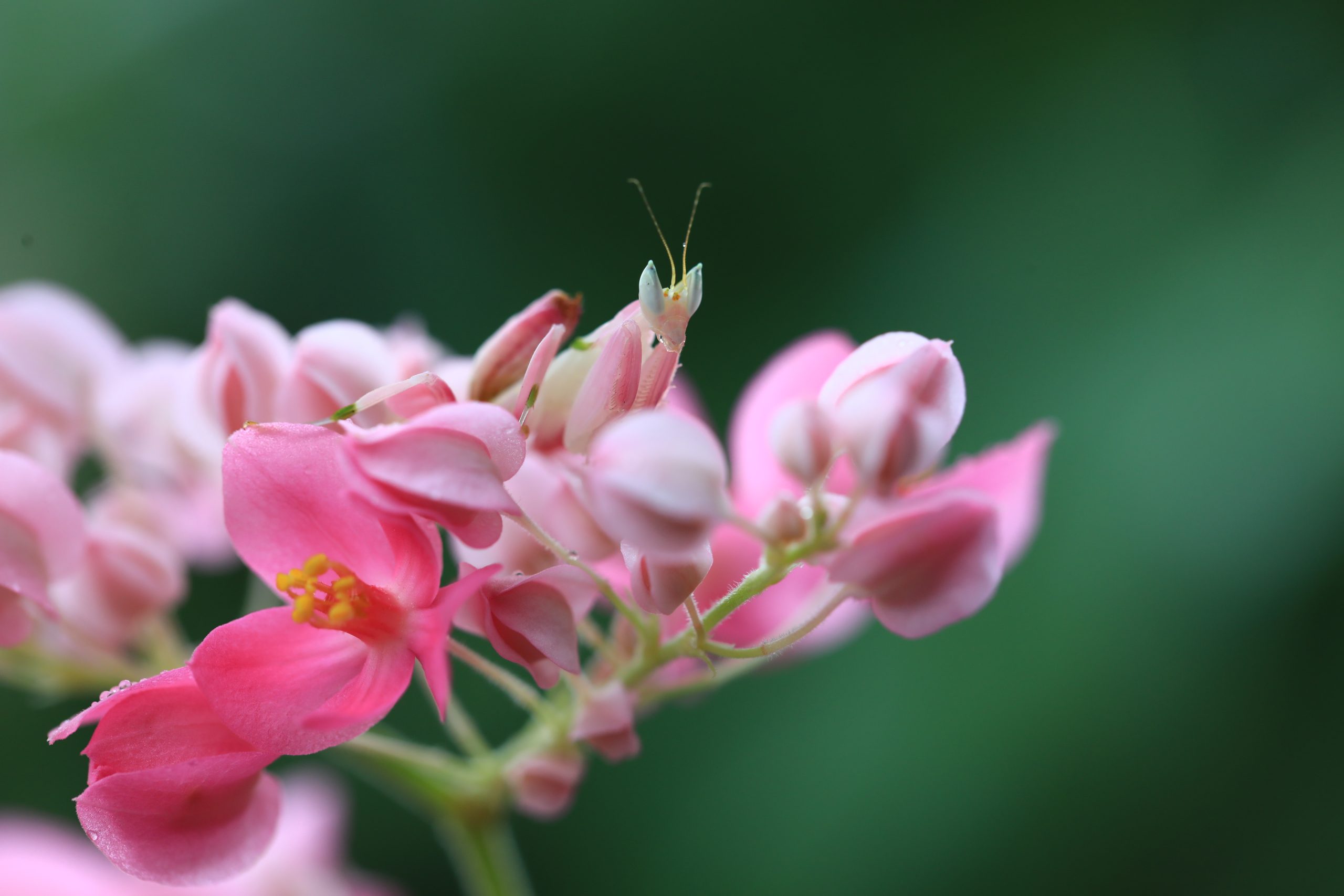
Some vanish almost completely among the petals of an orchid, others resemble a dried leaf or a slender twig. The world of praying mantises is far more diverse than the familiar green insect with folded raptorial forelegs that first comes to mind. Among their many species are remarkable predators with astonishing forms, all shaped by deception, patience and lightning-fast strikes.
Predators in a “praying” pose
Despite their name, praying mantises are not true grasshoppers. They form their own insect order, the Mantodea, which is part of the larger Dictyoptera lineage. According to modern phylogenetic studies – surprisingly enough – they are more closely related to cockroaches and termites than to true grasshoppers. Their distinctive predatory lifestyle and raptorial forelegs, modified for seizing prey, give them an unmistakably unique appearance.
Praying mantis refers to their characteristic posture. Their powerful, prey‑grasping forelegs are often held bent in front of the body, as if folded in prayer. In reality, however, this seemingly peaceful pose is a predator’s ready stance. The spiny forelegs can shoot forward in an instant when an insect comes within striking distance.
From the tropics to Hungary
Their species live primarily in warmer tropical and subtropical regions. Equatorial Africa is considered one of the major centres of praying mantis diversity. In Europe, by contrast, far fewer species occur, and the farther north we go, the rarer they become.
Hungary’s best‑known and only native representative is the European mantis (Mantis religiosa). This striking green or brown insect can appear in warm, sunny grasslands, shrublands, and even gardens. In Hungary it is a protected species, meaning it must not be collected from its natural habitat.
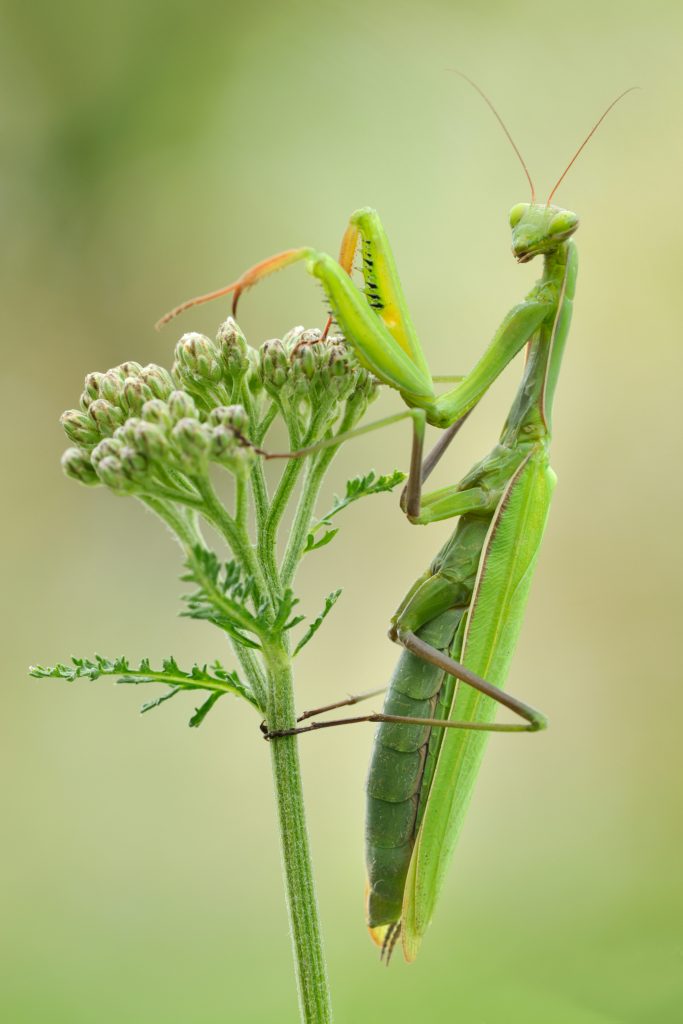
In recent years, however, two additional mantis species have established themselves in Hungary. Giant Asian mantis (Hierodula tenuidentata) and the much smaller, Mediterranean Ameles spallanzania. The spread of Hierodula tenuidentata within Hungary is documented by an increasing number of observations. The presence of Ameles spallanzania in the country, including breeding populations, has only recently been confirmed.¹
Elsewhere in the world, praying mantises show entirely different faces, from the African savannas to Asian rainforests and the tropical regions of South America. Across these varied habitats, their body shapes, colours and camouflage strategies are correspondingly diverse.
Masters of deception
One of the most striking features of praying mantises is the astonishing diversity of their body shapes and colours. Many species are closely adapted to the environments in which they live. Some resemble slender twigs, blend into tree bark, mimic dry leaves, appear moss-covered, or even look remarkably flower-like. Camouflage helps them both avoid their own predators and approach their prey unnoticed.
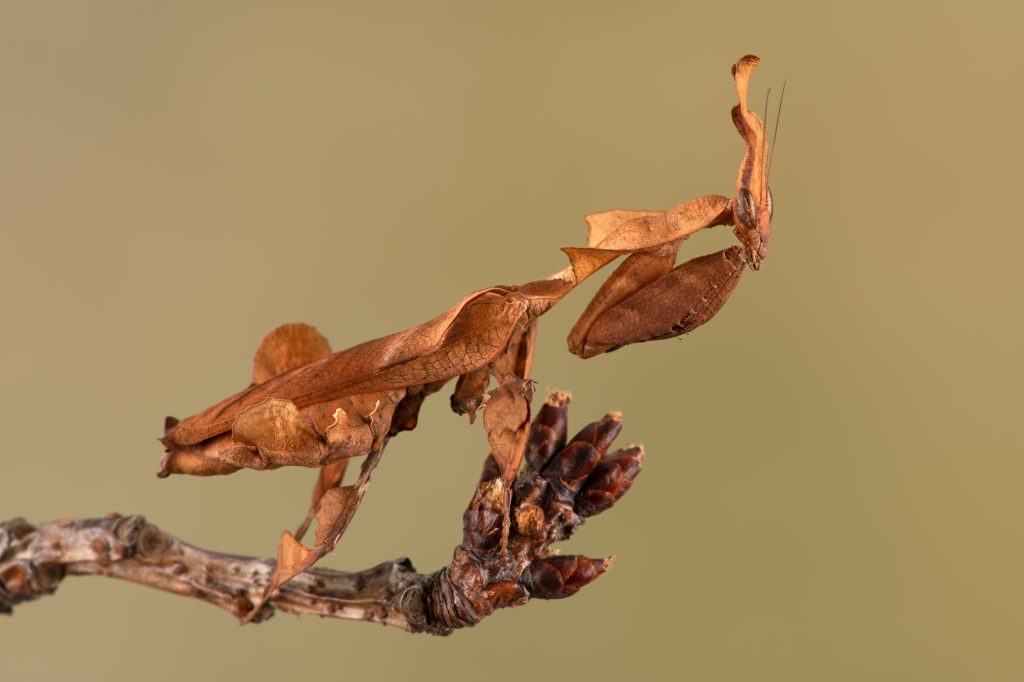
The ghost mantis (Phyllocrania paradoxa), for example, gives the impression of a dried leaf: its brownish colour, irregular body outline, and leaf‑like projections help it blend into dry plant material. Members of the genus Deroplatys take this strategy to an even more extreme level, with their broad, flattened bodies and crumpled‑leaf‑like contours.
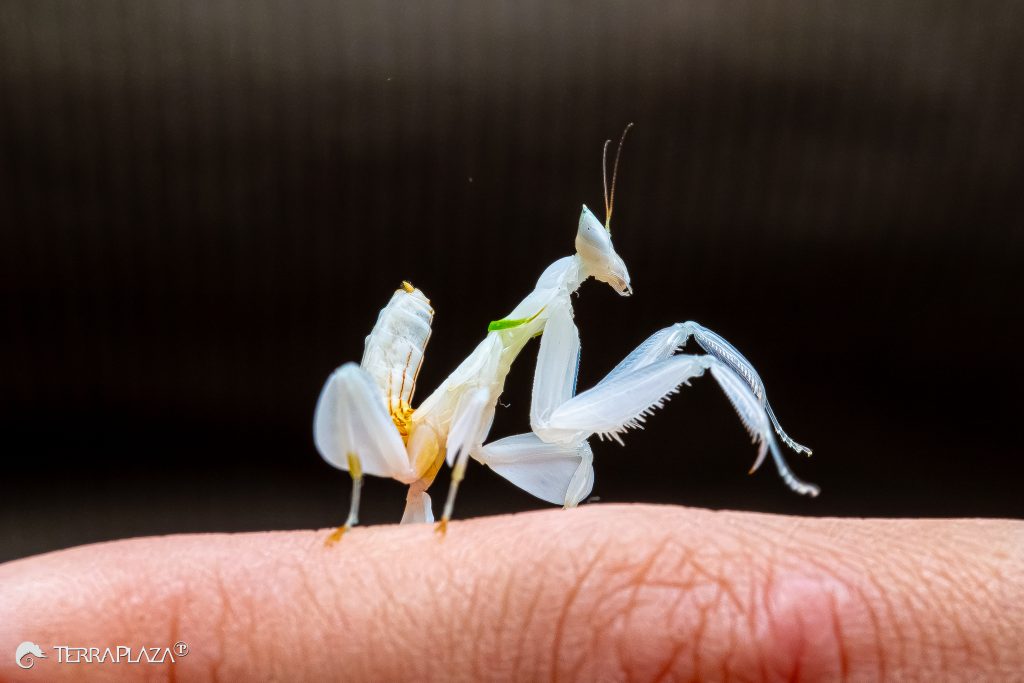
Flower‑mimicking species have taken a very different path. The best known among them is the orchid mantis (Hymenopus coronatus), whose whitish‑pink coloration, broad abdomen, and petal‑like leg lobes create the impression of a flower. Its appearance can do more than simply conceal it: studies suggest that it may actually attract flower‑visiting insects, meaning that in some cases the prey approaches the motionless predator on its own.
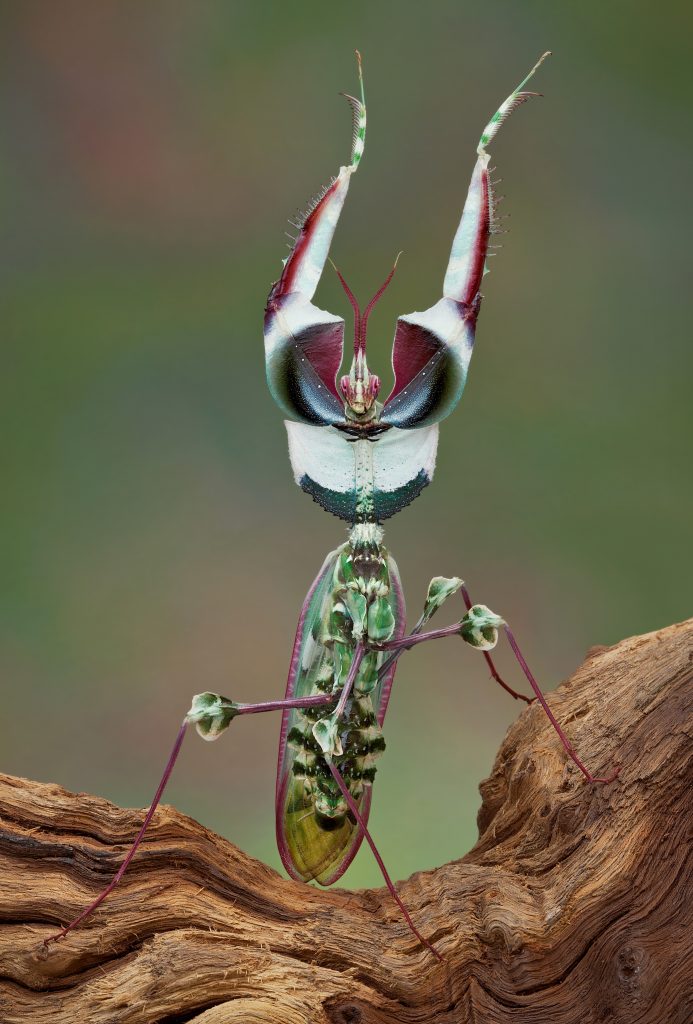
And even this does not mark the end of their diversity. Twig‑mimicking species, with their long, slender bodies and limbs, can disappear almost completely within the vegetation, while extravagant species such as the devil’s flower mantis (Idolomantis diabolica) display a spectacularly different expression of the same deceptive lifestyle with their elaborate lobes and striking patterns.
Lightning‑fast strikes and extraordinary vision
Praying mantises are patient hunters: they often wait motionless for long periods while watching their surroundings. When suitable prey comes within reach, however, calmness gives way to an exceptionally rapid strike. Their spiny raptorial forelegs shoot forward and close around the prey almost like a trap. Studies have shown that mantises can adjust the movement of their forelegs to the speed and distance of the target.
This precise attack is paired with remarkable vision. Praying mantises are among the few invertebrates in which stereoscopic, or three‑dimensional vision has been demonstrated, and they are one of its most thoroughly studied insect examples. By comparing the slight differences between the images perceived by their two compound eyes, they can estimate whether a moving prey item is at the right distance for a successful strike.
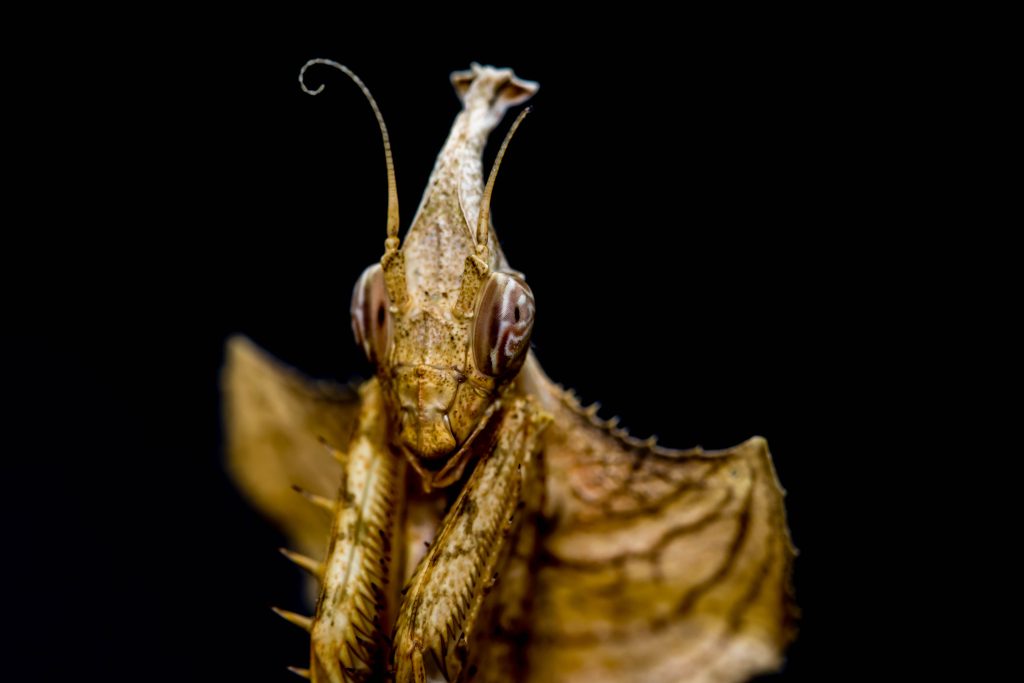
Photo: Mantis_Diabolica / stock.adobe.com
Experiments suggest that mantises primarily compare changes in moving image elements between their two eyes – a mechanism that is particularly effective for determining the position of a moving insect. In a special “insect 3D cinema,” researchers even placed tiny colour filters in front of mantises’ eyes and tested, using computer‑generated images, at what distance they perceived the virtual prey.
The mantises were most likely to strike when the visual scene indicated that the prey was about 2.5 centimetres away – within grasping distance.
The motionless waiting is therefore deceptive: the mantis is continuously watching, assessing the prey’s position, and only launches its forelegs when the right moment arrives.
Camouflage is more than concealment
A mantis’s camouflage does more than hide it from predators. As an ambush hunter, it gains just as important an advantage from remaining unnoticed by its prey. A body shape, coloration, and movement that resemble plant parts can therefore serve simultaneously as defence and as a hunting strategy.
This is perhaps what makes praying mantises so remarkable: they may look like flowers, leaves, or twigs, yet this deceptive appearance always serves the same purpose – to wait unnoticed for the perfect moment.
Sources:
