




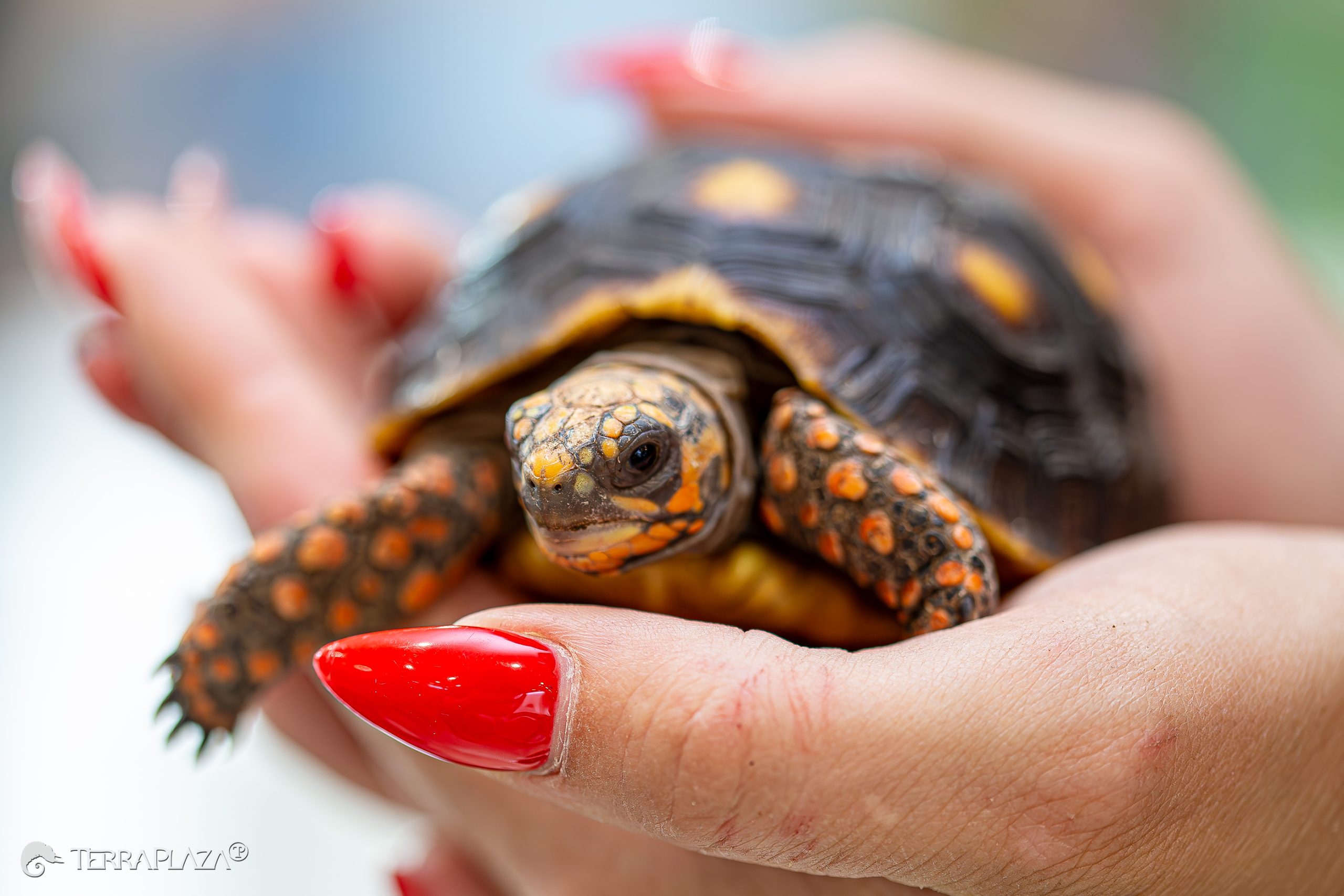
Tortoises have been present in European animal keeping for centuries. Documented examples of keeping Testudo graeca are known as early as the 17th century. In the centuries that followed, Mediterranean tortoises gradually became increasingly familiar as hobby animals. Today’s herpetoculture features terrestrial tortoises from many parts of the world, differing in size, appearance, natural habitat, and husbandry requirements. In this article, we have selected species that illustrate this diversity particularly well.
The classics: the Testudo species
Members of the genus Testudo are found from southern Europe through North Africa and Asia Minor all the way to Central Asia. Although they may appear similar at first glance. They can be clearly distinguished by the shape of their shell, their body size, and their natural habitat. These differences are reflected in their husbandry as well: not all Testudo species thrive under the same climate conditions or require the same type of winter dormancy.
Hermann’s tortoise (Testudo hermanni)
Hermann’s tortoise is one of the best‑known terrestrial tortoises of southern Europe. It inhabits Mediterranean scrublands, dry grasslands, open woodlands, and sunny, rocky areas. The species has two recognised subspecies: the western Hermann’s tortoise (Testudo hermanni hermanni) and the eastern Hermann’s tortoise (Testudo hermanni boettgeri).
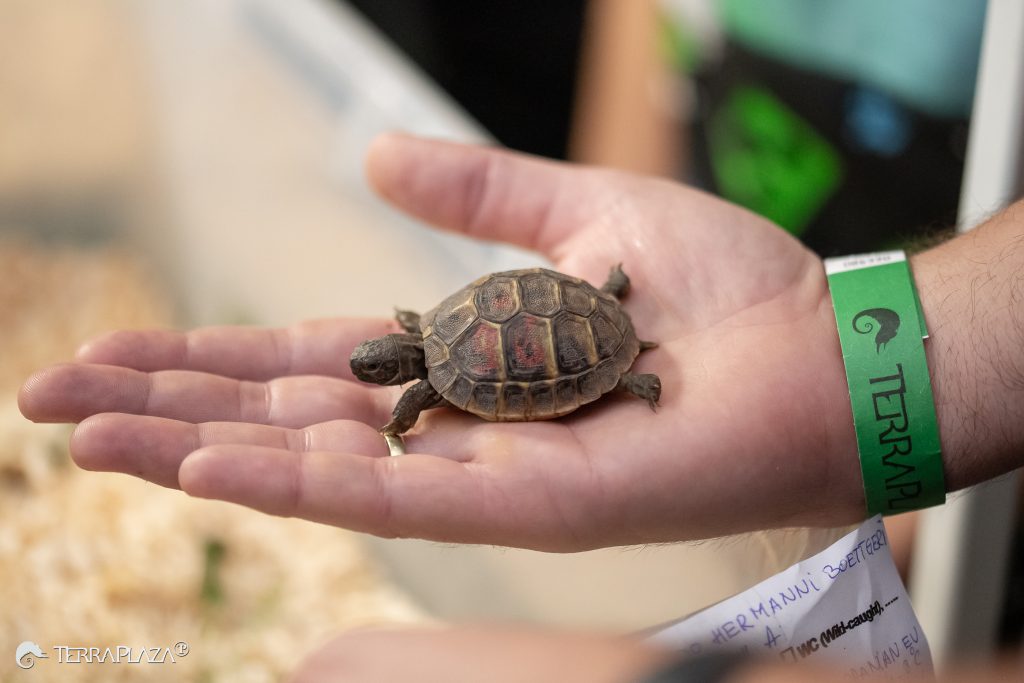
The western subspecies, T. h. hermanni, occurs in the Mediterranean regions of Western Europe. It is generally smaller: most individuals measure around 14–17 centimetres, and only rarely reach or exceed 20 centimetres. Its shell is typically brighter and more contrasting, with a vivid yellow‑and‑black pattern. The plastron usually shows two clearly defined, longitudinal black stripes.
The eastern subspecies, T. h. boettgeri, is native primarily to the Balkan region. It is generally larger and more robust than its western relative; females in particular may grow beyond 20 centimetres. Its coloration is more variable and often less vivid and contrasting. The black stripes on the plastron are usually less continuous and regular than in the western subspecies.
Spur‑thighed tortoise (Testudo graeca)
The spur‑thighed tortoise is a far more complex case. Its distribution extends from North Africa through the Balkans and Asia Minor to Western Asia. This wide range has produced highly diverse populations that differ both in appearance and in the climates they inhabit. A characteristic feature of the species is the pair of keratinous tubercles or “spurs” located on the back of the thighs.
Its subspecific classification is particularly complicated and partly debated. The Reptile Database currently recognises, among others, the forms T. g. graeca, T. g. ibera, T. g. terrestris, and T. g. nabeulensis. In herpetoculture, the name ibera is especially common: these animals are generally larger and more robust, often reaching or exceeding a shell length of around 25 centimetres. In contrast, the Middle Eastern terrestris is typically smaller, lighter in colour, and more yellowish in appearance.
Knowing the precise origin of a spur‑thighed tortoise is particularly important.
This has direct relevance for its husbandry. European and Anatolian forms may include a pronounced winter dormancy period in their natural life cycle. In contrast, some North African populations are adapted to much milder winters and enter deep dormancy only briefly or not at all. For this reason, the name “spur‑thighed tortoise” alone is not sufficient to determine the appropriate overwintering method.
Russian tortoise (Testudo horsfieldii)
The Russian tortoise comes from a very different environment: it inhabits the dry steppes, semi‑desert regions, and mountainous plateaus of Central Asia. Its shell is flatter and more rounded than that of Mediterranean species, and one of its most easily recognisable features is that it has four claws on each of its four limbs. It typically measures between 13 and 20 centimetres, with females usually growing larger than males.
The Reptile Database currently lists five subspecies within T. horsfieldii, including T. h. horsfieldii, T. h. kazachstanica, and T. h. rustamovi. In practice, however, captive animals are often simply referred to as Russian tortoises, and their exact subspecific origin is not always known.
One of the most important aspects of its lifestyle is its exceptional burrowing ability. In its natural habitat, it constructs long tunnels in which it can survive both winter cold and summer heat. For this reason, deep, well‑draining, easily burrowable substrate is essential in captivity, along with an escape‑proof enclosure. Persistently damp conditions are less suitable for a species adapted to a dry, continental environment.
Marginated tortoise (Testudo marginata)
The marginated tortoise is one of the largest members of the genus Testudo: adult individuals can reach a shell length of 25–30 centimetres. It is native to Greece and Albania, where it inhabits dry, rocky, shrub‑covered mountain slopes.
Its name comes from its most striking characteristic: in adult animals, the rear marginal scutes are strongly flared, forming a distinctive, skirt‑like rim. Its shell is generally darker, often greyish‑black, giving it a markedly different appearance from the more yellowish hermanni or graeca forms.
Interestingly, the smaller so‑called weissingeri form was previously treated as a separate species or subspecies. Current taxonomy, however, does not recognise it as an independent taxon; the observed differences are instead attributed to local environmental influences.
Husbandry is fundamentally similar to that of other Mediterranean Testudo species, but due to its larger size and active movement, it requires particularly spacious accommodation.
Africa’s patterned tortoise: the leopard tortoise (Stigmochelys pardalis)
The leopard tortoise is widespread across vast regions of East and southern Africa: it occurs from Ethiopia and Somalia through East Africa all the way to South Africa. Its habitats are extremely diverse, ranging from dry and more humid savannas, grasslands, and thorny scrublands to semi‑arid areas and certain mountainous regions. It may even be found at elevations above 2000 metres.
Its name derives from its striking shell pattern. Juveniles have a yellowish or light brown base colour marked with dark spots and irregular blotches reminiscent of a leopard’s coat. As the animals age, the pattern often becomes paler and less contrasting. The shell is high and strongly domed, and one of the characteristic features of the species is the absence of a nuchal scute.
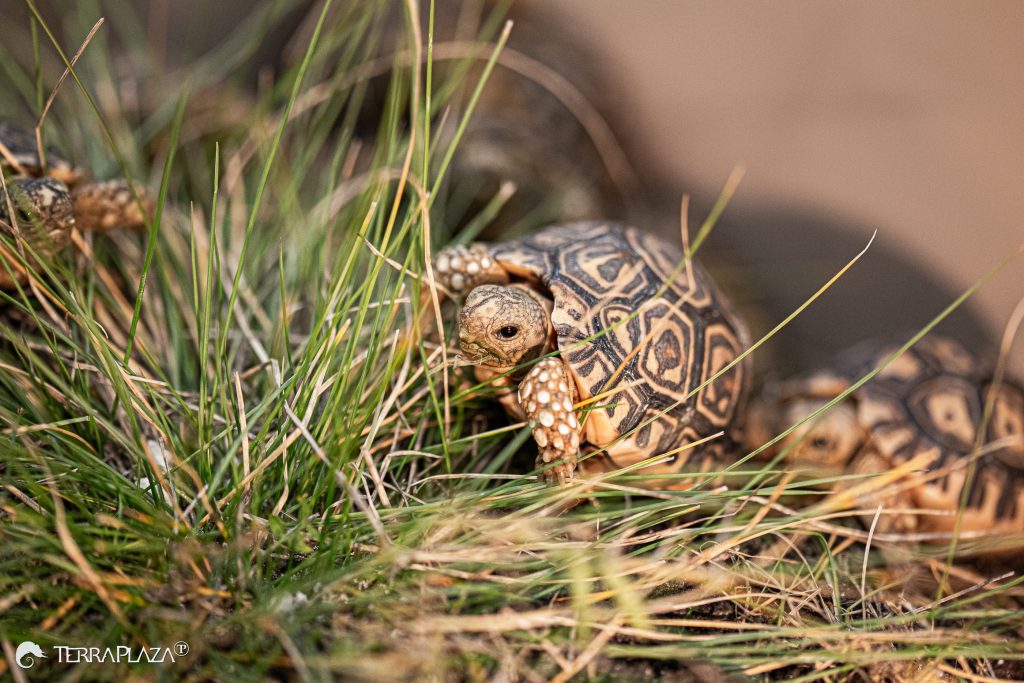
There are considerable geographical differences in size. Many adult individuals reach a shell length of around 30–45 centimetres, and females typically grow larger than males. However, some populations include much bigger animals: exceptional specimens may exceed 70 centimetres in length and weigh more than 40 kilograms.
Due to its substantial space requirements, keeping this species is a more demanding task than caring for the smaller Testudo species. It needs a warm, sunny environment and ample room to move, while its diet should be based on fibre‑rich vegetation, particularly grasses and other herbaceous plants. It is not a species that should be overwintered, and it is especially sensitive to cold, persistently damp conditions.
A tropical outlier: the red‑footed tortoise (Chelonoidis carbonarius)
The red‑footed tortoise is widespread across much of South America. It occurs from Colombia, Venezuela, and the Guianas through Brazil and Bolivia to Paraguay and northern Argentina.Its habitats are quite diverse: it can be found in humid forests and forest edges, including certain peripheral areas of the Amazon Basin. Drier deciduous forests, as well as more open environments such as savannas, grasslands, and scrublands. It is particularly characteristic of mosaic habitats where wooded and open areas alternate.
Its name refers to its dark, brownish‑black shell, but its most striking features are the bright yellow, orange, or red scales visible on the head and limbs. Adult individuals typically reach a shell length of around 25–35 centimetres, with males generally growing larger than females.
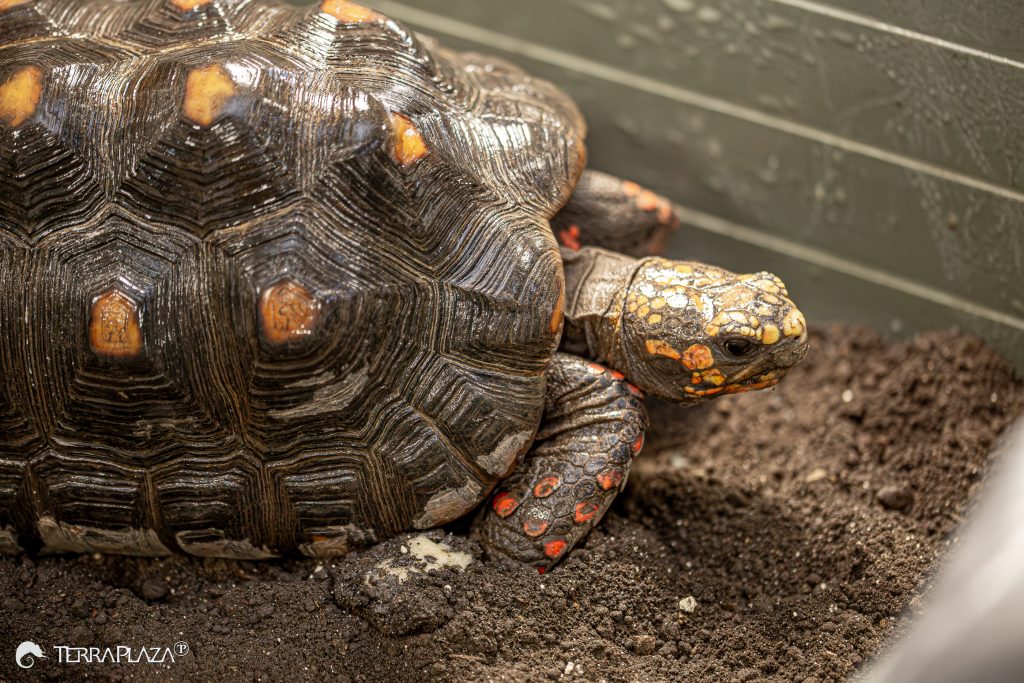
Its husbandry differs from that of Testudo species in several important ways. It requires a warmer, more humid environment and cannot be overwintered in the manner typical of temperate‑zone tortoises. Its diet is also more varied. It feeds primarily on plant matter-leaves, flowers, fruits, and fungi, but under natural conditions it also consumes small amounts of animal‑based food, such as invertebrates.
A star‑patterned rarity: the Indian star tortoise (Geochelone elegans)
The Indian star tortoise is native to the Indian subcontinent: it occurs across much of India, in the southeastern regions of Pakistan, and in Sri Lanka. It primarily inhabits dry and semi‑arid scrublands, grasslands, and coastal thickets, but it may also appear in agricultural areas and plantations.
Its life is strongly shaped by the monsoon: during the rainy season it becomes far more active, feeds more frequently, and much of its breeding activity also takes place at this time.
Its most striking feature is the yellowish, radiating star pattern that emerges from the centre of the dark scutes, giving the species its name. The pattern is not only decorative, it can help break up the animal’s outline among dry grasses and shrubs. Females are generally larger than males; females typically reach a shell length of around 30 centimetres, while males are usually smaller.
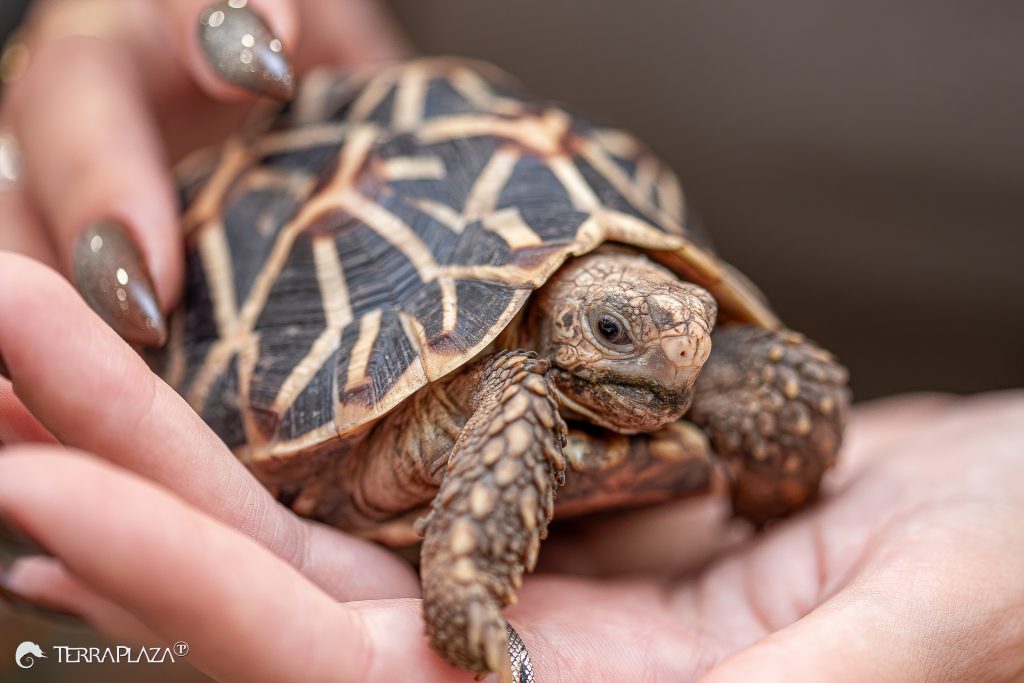
Its husbandry differs from that of Mediterranean Testudo species. It is a heat‑demanding tortoise that is not overwintered, and it requires appropriate temperatures year‑round, UVB lighting, and a well‑structured thermal gradient. Although its natural habitat can be dry for much of the year, the monsoon brings seasonally much more humid conditions, and the species is adapted to this; therefore, especially for juveniles, it is not advisable to maintain an environment that is persistently too dry.
Its diet consists primarily of grasses and other fibre‑rich plant material, so in captivity a varied, high‑fibre plant‑based diet is essential.
The giants: the Aldabra giant tortoise and the African spurred tortoise
The Aldabra giant tortoise (Aldabrachelys gigantea) is native to the Aldabra Atoll, part of the Seychelles. It occurs in the atoll’s grassy areas, scrublands, coastal dunes, and near mangroves. Its long neck allows it to reach not only low‑growing vegetation but also higher leaves and shoots. Its diet consists predominantly of grasses, leaves, and other plant material.
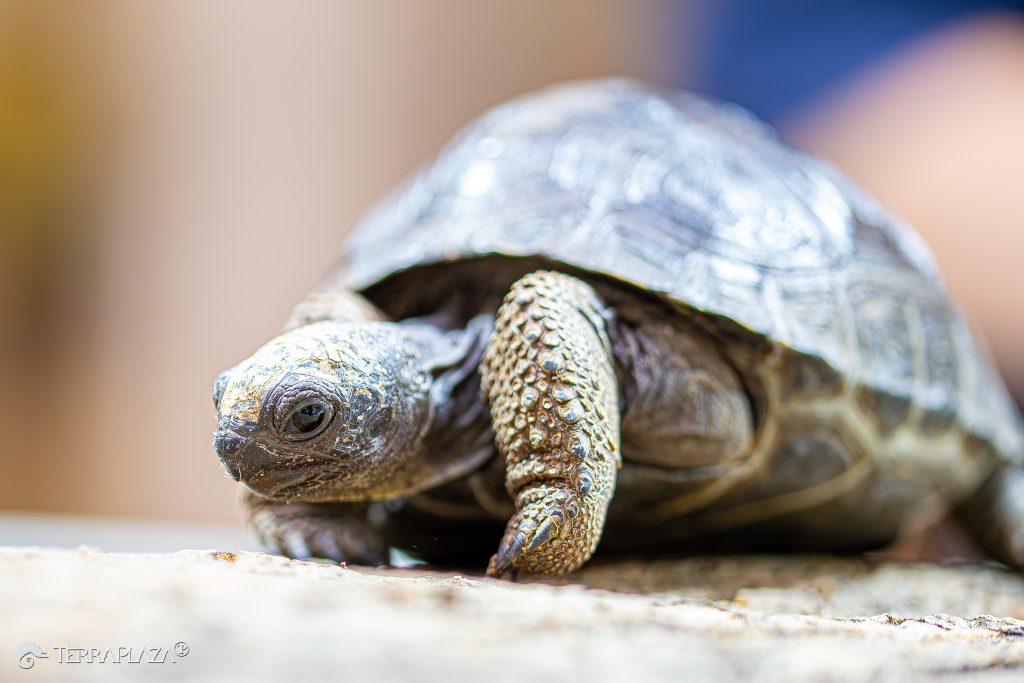
True to its name, it is one of the largest tortoises in the world. Males can reach a shell length of up to 1.2 metres and may weigh as much as 250 kilograms, while females are generally smaller.
Their lifespan is likewise extraordinary: they can live well beyond 100 years, and ages around 150 years are not without precedent.
Much smaller – though still impressively large – is the African spurred tortoise (Centrochelys sulcata), which is native to the dry savannas and semi‑desert regions of the Sahel, the belt bordering the southern edge of the Sahara. Its range extends from Senegal and Mauritania all the way to Sudan, Eritrea, and Ethiopia. To escape the intense heat, it retreats into deep burrows; these tunnels can reach several metres in depth. The species gets its name from the prominent keratinous “spurs” on its hind legs.
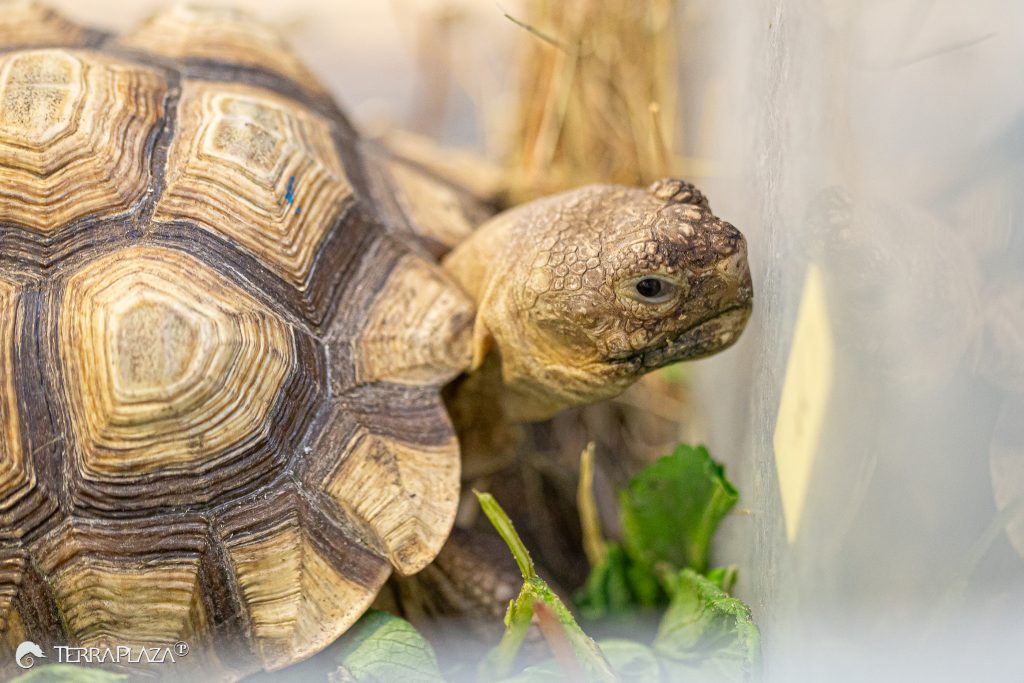
The African spurred tortoise is the largest tortoise on the African continent. Larger males can reach a shell length of 70–80 centimetres and may weigh up to 90 kilograms.
It primarily consumes grasses, weeds, and other fibre‑rich plants. Although juveniles may seem manageable in size, their rapid growth means that adults become huge, powerful, and extremely active animals.
These two species clearly illustrate that some tortoises require conditions far beyond what a traditional terrarium can offer. Both the Aldabra giant tortoise and the African spurred tortoise need extensive, securely constructed outdoor areas and adequately heated shelters for cooler periods. As a result, keeping them long‑term demands substantial space and significant infrastructure.
Commitment
When choosing a tortoise, it is advisable to thoroughly research the species’ size, lifespan, husbandry requirements, and space needs. Only a species for which we can provide appropriate conditions over many years should be selected.
Once we have identified the species that suits us, it is also important to check the legal regulations concerning its keeping and trade.
Many tortoise species are subject to conservation and trade controls, so verifying the current legal status of the species is essential. Depending on the species, a certificate of origin, an EU permit, or other official documentation may be required. Only animals of verified origin and accompanied by the necessary documents should be purchased.
