




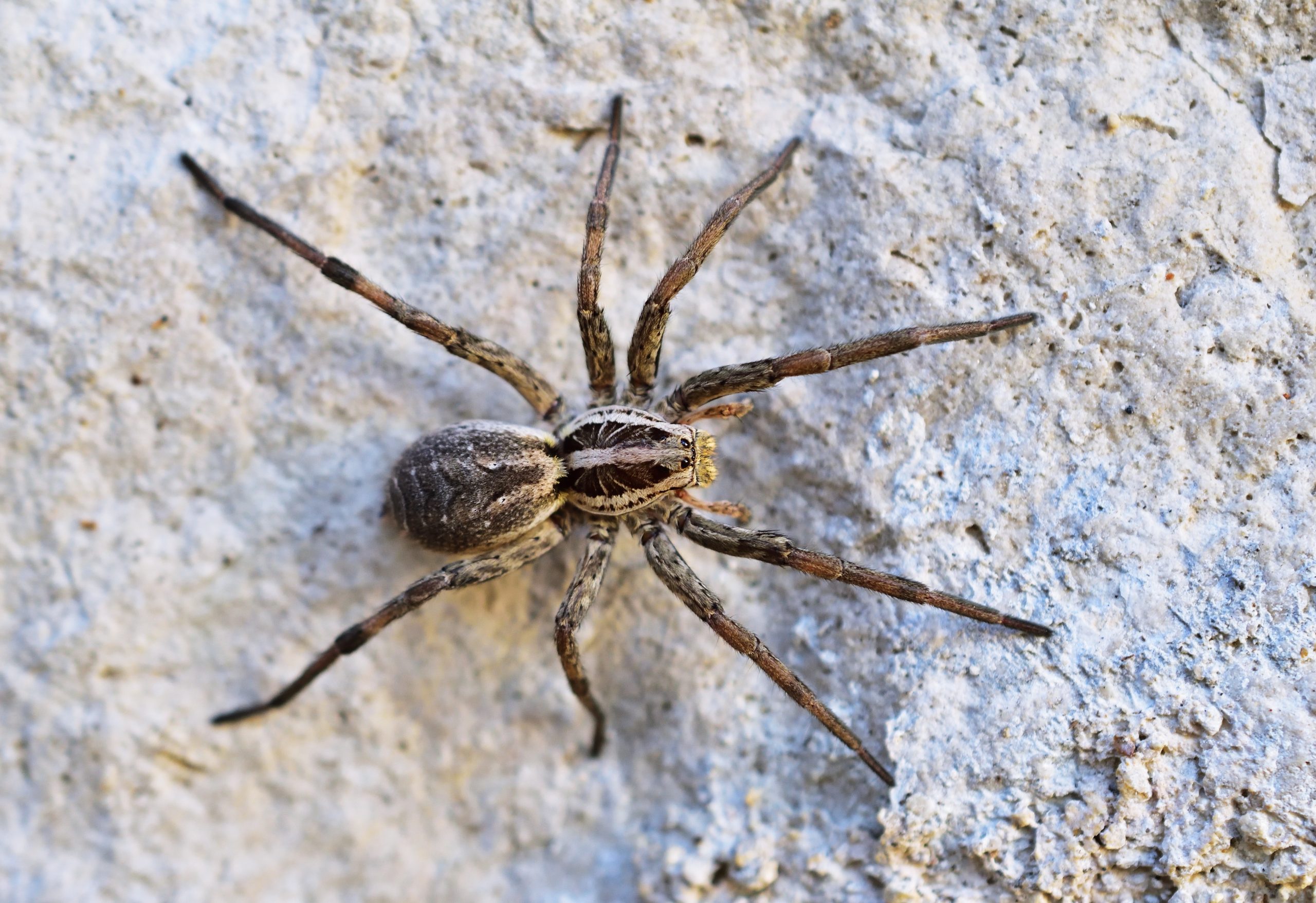
Huge spiders, unexpected encounters and a growing number of sightings have attracted widespread attention in recent days. Reports of tarantulas spreading across Austria have quickly circulated online. In just two months, more than 200 sightings were reported. Some of these large spiders have even appeared in houses and garages. But is this really an invasion? In fact, a fascinating natural phenomenon lies behind the headlines. Moreover, the story has a close connection to Hungary.
More than 200 tarantula sightings in two months
In early November 2026, an unusual story caught the attention of the Austrian and international media. According to a report published by the Austrian conservation organisation Naturschutzbund Österreich on 5 November, more than 200 sightings had been submitted since early September. These reports involved two large spider species native to Austria.
The observations were recorded on naturbeobachtung.at, a citizen science platform for recording wildlife. Of these reports, experts confirmed 175 sightings.
Most of the documented sightings came from three Austrian federal states:
- Styria: 66 sightings
- Lower Austria: 49 sightings
- Burgenland: 43 sightings
Additional reports came from other areas, including Vienna and Carinthia. Meanwhile, the story quickly attracted international attention. On 8 November, Euronews published an article describing the events as a tarantula invasion.
However, it is important to distinguish between an increase in reported sightings and actual population growth. More than 200 reports do not automatically mean that spider populations have increased dramatically.
Increased public participation in wildlife recording may also help explain the higher number of reports. Naturschutzbund Österreich specifically encouraged residents to share observations of the two native spider species on naturbeobachtung.at. Experts verify the submitted observations. As a result, public participation provides valuable information for scientific research into the species’ distribution and possible range expansion. Therefore, the high number of reports alone does not prove that spider populations have increased dramatically.
What kind of tarantulas are they really?
On hearing the news, many people probably imagine enormous tropical tarantulas appearing unexpectedly in Central Europe. However, the reality is very different. The spiders observed in Austria are not escaped exotic tarantulas. Instead, they are naturally occurring European species belonging to the wolf spider family (Lycosidae).
The first species is Lycosa singoriensis, commonly known as the South Russian tarantula. The second is the wolf spider Hogna radiata. Austrian media refer to this species as the black-bellied tarantula.
The name ‘tarantula’ can easily cause confusion. In modern English, it usually refers to spiders of the family Theraphosidae. However, in several European languages, the term has historically also been used for certain large wolf spiders.
Therefore, the two Austrian species do not belong to the same taxonomic family as the tarantulas familiar to terrarium enthusiasts. Nevertheless, their appearance is genuinely impressive.
The South Russian tarantula is one of the largest spiders in Central Europe. Its body can reach 4 cm in length, while its leg span may extend to approximately 10 cm. With its robust build, hairy legs and distinctive markings, this spider can be an imposing sight. The species mainly inhabits dry, open landscapes, including sandy grasslands and saline steppes. It shelters in burrows dug into the ground and reinforced with spider silk. From these retreats, it hunts smaller arthropods that pass nearby.
Why are more people encountering them now?
The increased activity observed during autumn has a natural explanation.
Seasonal changes play an important role in the lives of wolf spiders. During the mating season, males may leave their usual retreats in search of females.
As autumn approaches, finding a suitable place to overwinter also becomes increasingly important. The spiders seek sheltered, frost-free hiding places. In natural habitats, these may include underground burrows or crevices in rocks.
However, their movements sometimes bring them into human buildings. Encountering a large spider in a garage or house can understandably come as a surprise. Nevertheless, its presence does not necessarily indicate anything unusual.
According to Austrian conservationists, some of the recent sightings can be explained by this seasonal activity.
Modern technology also contributes to the growing number of documented encounters. For example, a photograph taken with a smartphone can now reach species identification experts within moments. Consequently, observations that might once have gone unrecorded can now contribute to scientific research.
Are the species really expanding their ranges?
Alongside the increased public attention, researchers have recorded several particularly interesting sightings.
For example, the South Russian tarantula was observed near Tulln in Lower Austria. This location is unusually far to the north-west compared with the species’ previously documented Austrian occurrences. According to Carolina Trcka-Rojas, an expert at Naturschutzbund Österreich, no previous reports of the species had been received from the surrounding area.
Researchers have also recorded noteworthy observations of Hogna radiata. A sighting in the Gail Valley in Carinthia represented the species’ westernmost documented occurrence in Austria. Meanwhile, another observation in Burgenland was recorded near the northern limit of its known distribution. These records may help researchers better understand how the geographical ranges of both species are changing.
Climate change may also be contributing to this phenomenon. A scientific study published in the Journal of Insect Conservation in 2025 examined historical changes in the distribution of Lycosa singoriensis in the Czech Republic. The researchers found that certain periods of range expansion coincided with warmer and drier summers than average. Their findings suggest that changing climatic conditions may play an important role in shaping the species’ regional distribution. However, this does not mean that every new Austrian sighting is a direct consequence of climate change. Establishing such a connection requires longer-term, comparable observation data.
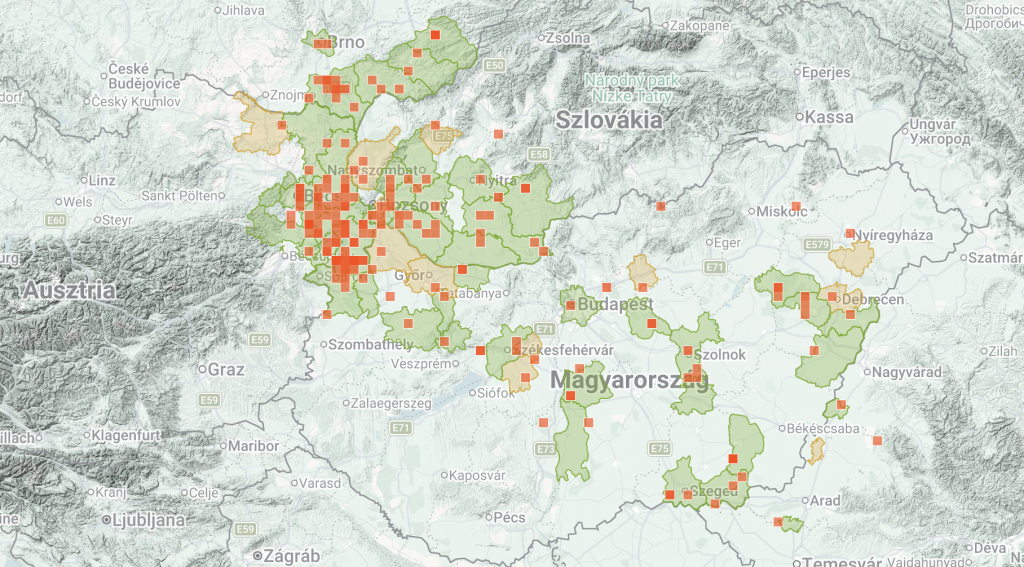
The South russian tarantula is native to Hungary, too!
One detail of the Austrian reports may be particularly interesting to Hungarian readers.
The South Russian tarantula (Lycosa singoriensis) is native to Hungary and is a legally protected species.
It mainly inhabits open grasslands with sparse vegetation, sandy areas and saline steppes. However, it can occasionally also occur near inhabited areas.
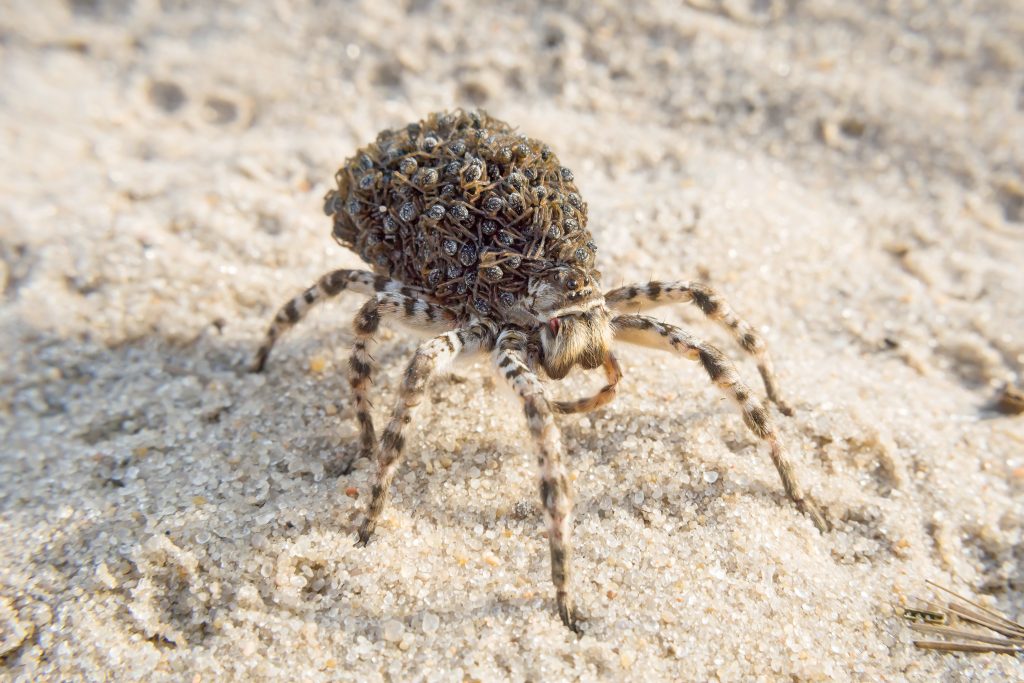
On 25 October 2026, the Körös–Maros National Park Directorate reported some particularly interesting autumn observations of this species. Conservation specialists observed several females carrying their tiny offspring on their backs. This is one of the distinctive behaviours found among wolf spiders.
Female wolf spiders carry their newly hatched young on their bodies for a period of time, providing protection during the early stages of their development.
Are they dangerous to humans?
One of the most important questions raised by the reports is whether people should be afraid of these large spiders. According to Austrian conservation experts, neither species poses a significant threat to humans.
Wolf spiders do not actively seek encounters with people. Instead, they typically respond to disturbance by attempting to escape.
However, it is important to remember that the South Russian tarantula is venomous and can bite in self-defence. A bite may be painful and cause local swelling or redness. Nevertheless, it generally does not result in serious consequences for healthy adults. Therefore, these spiders should not be handled with bare hands or disturbed unnecessarily.
If a spider enters a house, it is best to carefully capture it using a suitably sized container and a piece of cardboard. It can then be released nearby in an appropriate habitat.
Austrian conservationists also emphasise that these spiders should not be killed or collected from the wild for private keeping.
In Hungary, the South Russian tarantula is a protected species with a legally assigned conservation value of HUF 5,000.
A remarkable natural story, not an invasion
More than 200 reported tarantula sightings in Austria are undoubtedly noteworthy. However, the phenomenon behind the dramatic headlines is considerably more complex.
This is not a mass arrival of exotic tarantulas. Instead, it involves native wolf spider species whose natural movements and changing distributions are attracting increasing attention.
Seasonal behaviour, citizen science observations, habitat changes and the possible effects of climate change all play a part in the story. The recent sightings provide valuable information for researchers. Over time, these records may help scientists develop a clearer understanding of the lives and distribution of these remarkable animals.
The presence of the South Russian tarantula in Hungary also reminds us of something important. Some of nature’s most fascinating creatures do not need to be discovered on distant continents. Sometimes, we simply need to take a closer look at the wildlife that has been living alongside us all along.
Sources
1. Naturschutzbund Österreich (5 November 2026)
Schaurig-schön: Taranteln breiten sich weiter in Österreich aus.
Official statement by the Austrian conservation organisation.
Primary source for the number and geographical distribution of sightings, species ranges and expert observations.
2. Euronews – Kevin Koehrmann (8 November 2026)
Tarantula invasion in Austria: More than 200 sightings in two months.
Original Hungarian-language news report.
3. Der Standard – Karin Krichmayr (7 November 2026)
Taranteln breiten sich weiter aus: 175 Sichtungen in zwei Monaten.
4. Hortobágy National Park Directorate
South Russian tarantula (Lycosa singoriensis) – Species profile.
Scientific information on the species’ occurrence, ecology and conservation status in Hungary.
5. Körös–Maros National Park Directorate (25 October 2026)
Carrying My Young: South Russian Tarantulas on the Dévaványa–Ecseg Plains.
Original national park report.
6. Řezáč, M. & Heneberg, P. (2025)
A spider on the edge: century-scale shifts at the northwestern distribution limit of Lycosa singoriensis.
Journal of Insect Conservation, 29, Article 81.
Published: 15 October 2025.
DOI: 10.1007/s10841-025-00717-0
Scientific investigation of historical distribution changes in the Czech Republic and their relationship with climatic conditions.
