




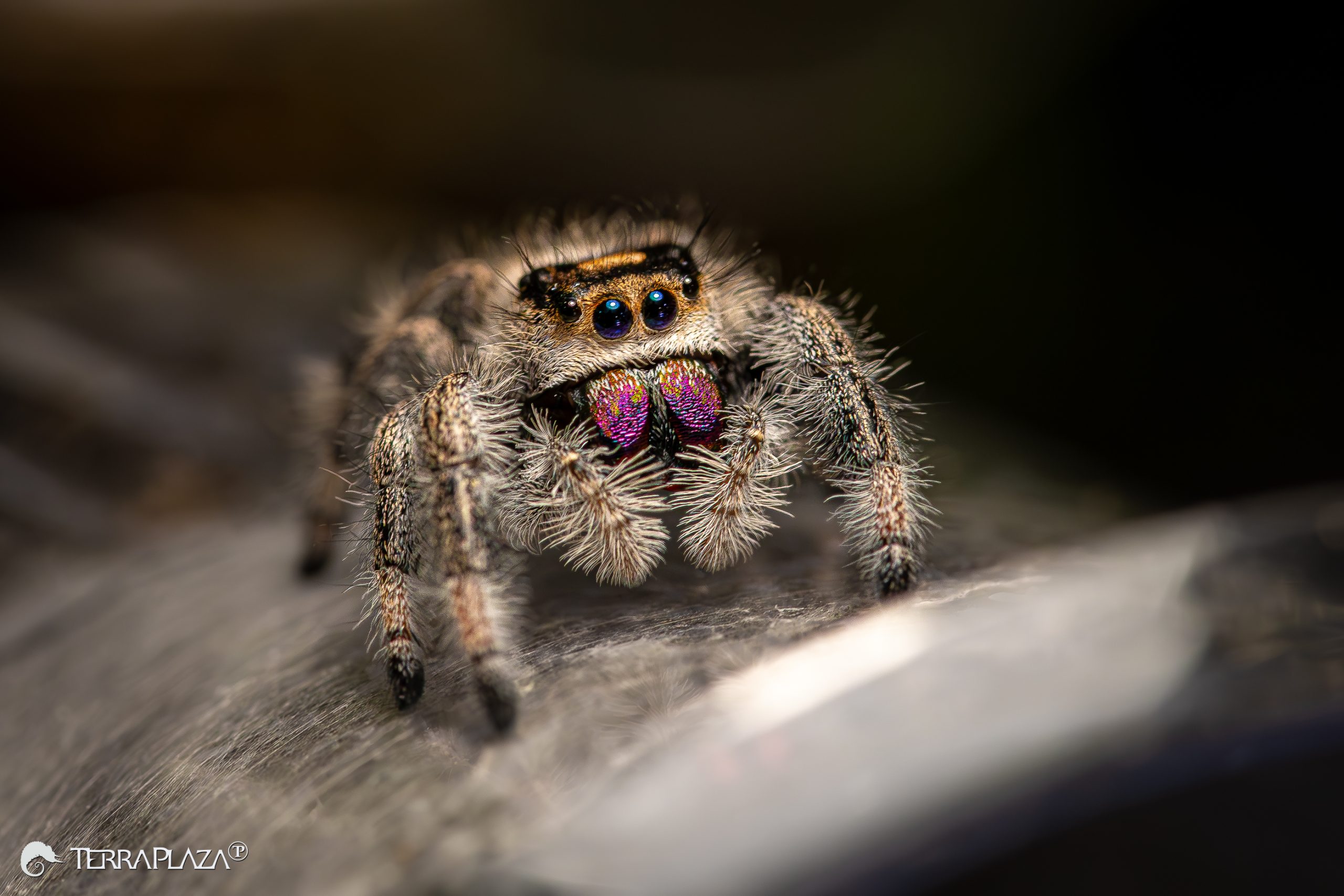
Jumping spiders are becoming increasingly popular among terrarium keepers. Their excellent eyesight, extraordinary jumping ability and inquisitive, active behaviour make them particularly appealing to enthusiasts. Unlike spiders that hunt using webs, they do not rely on prey-catching webs. Instead, they depend on their keen vision and precisely timed leaps.
The Phidippus regius ‘Bahamas’ form is particularly popular in the terrarium hobby. The ‘Bahamas’ name reflects this form’s geographical association with the islands. In addition, females often display varied, pale colouration. The species’ lively behaviour also adds to its appeal. Despite its small size, it is a remarkable predator that actively explores its surroundings and can detect moving prey even from a distance.
In this article, we explore the origins of Phidippus regius ‘Bahamas’ and its remarkable vision and hunting techniques. We also look at its fascinating behaviour. Finally, we explain what to consider when keeping this jumping spider in a terrarium.
From the Bahamas to the terrarium
The natural range of Phidippus regius extends from the south-eastern United States, particularly Florida, through the Caribbean, including the Bahamas and the Greater Antilles.
In the terrarium hobby, the designation ‘Bahamas’ refers to a geographical form associated with the Bahamas, rather than a separate species or subspecies. Individuals from different localities may vary in appearance, particularly in the colouration of females, which can range from shades of grey and brown to lighter, orange tones.
In its natural habitat, Phidippus regius often moves across leaves, branches and other sunlit surfaces. As it explores its surroundings, it uses its excellent eyesight to search for food. Denser vegetation also provides hiding places where it can retreat to rest or moult.
Small body, striking appearance
Phidippus regius is one of the larger members of the jumping spider family. Adult females generally measure 7–22 mm in body length, while males range from 6–18 mm. Males and females differ noticeably in both size and colouration. As a result, mature individuals can often be distinguished by their appearance alone.
Females of the ‘Bahamas’ form are particularly well known for their varied colouration. Their bodies may be covered in cream, beige, grey or even orange hairs and scale-like structures. Some individuals may be almost entirely white, while others display darker markings. Males, by contrast, are typically black and white, with contrasting spots and patterns on their abdomens.
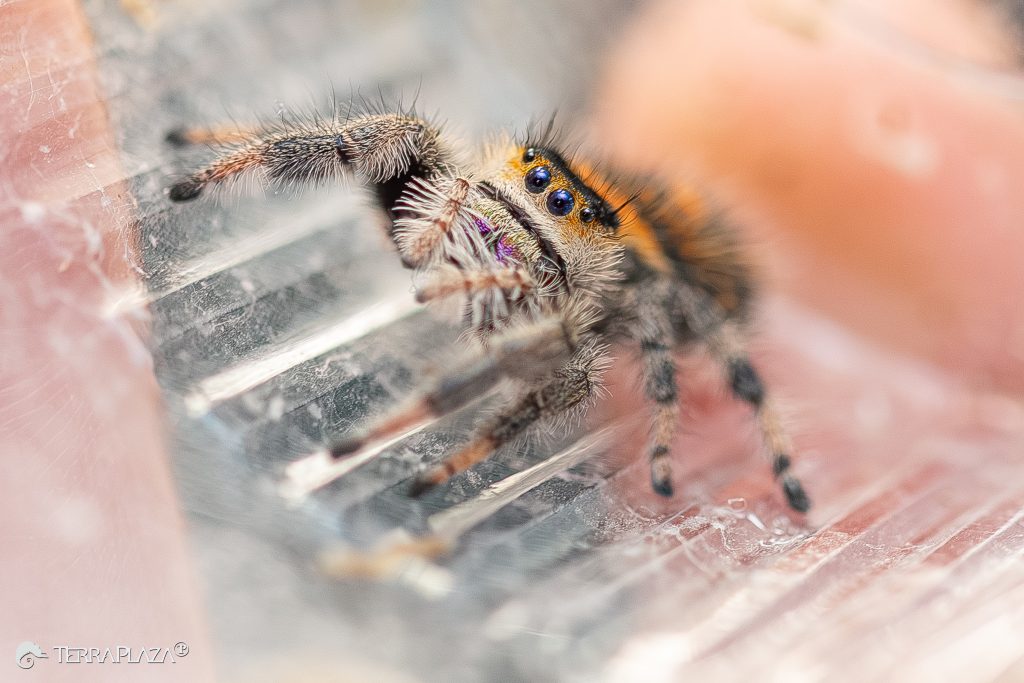
One of the species’ most striking features is its metallic-looking chelicerae. In males, these often have greenish-blue hues, while females may display greenish, purplish or reddish tones. The iridescent colour of the chelicerae can appear to change depending on the angle of the light, making these spiders even more distinctive.
Seeing the world through eight eyes
One of the most remarkable characteristics of Phidippus regius is its highly developed vision. This plays an important role in navigation and hunting. In addition, it helps the spider recognise members of its own species. Unlike most spiders, jumping spiders do not rely primarily on vibrations. Instead, they actively observe and explore their surroundings using their eyesight.
The eight eyes located on the cephalothorax perform different functions. The two large, forward-facing central eyes provide exceptionally detailed vision, while the smaller eyes at the sides offer a wider field of view and help detect movement. This combination allows the spider to notice approaching prey and then accurately assess its position and distance.
Phidippus regius can also perceive colours, and its vision plays an important role not only in capturing prey but also in mate selection. Interestingly, despite its sophisticated visual system, it cannot move its eyeballs in the same way humans do. Instead, internal muscles move the retinas of its principal eyes, while the spider can also turn its cephalothorax to follow events in its surroundings.
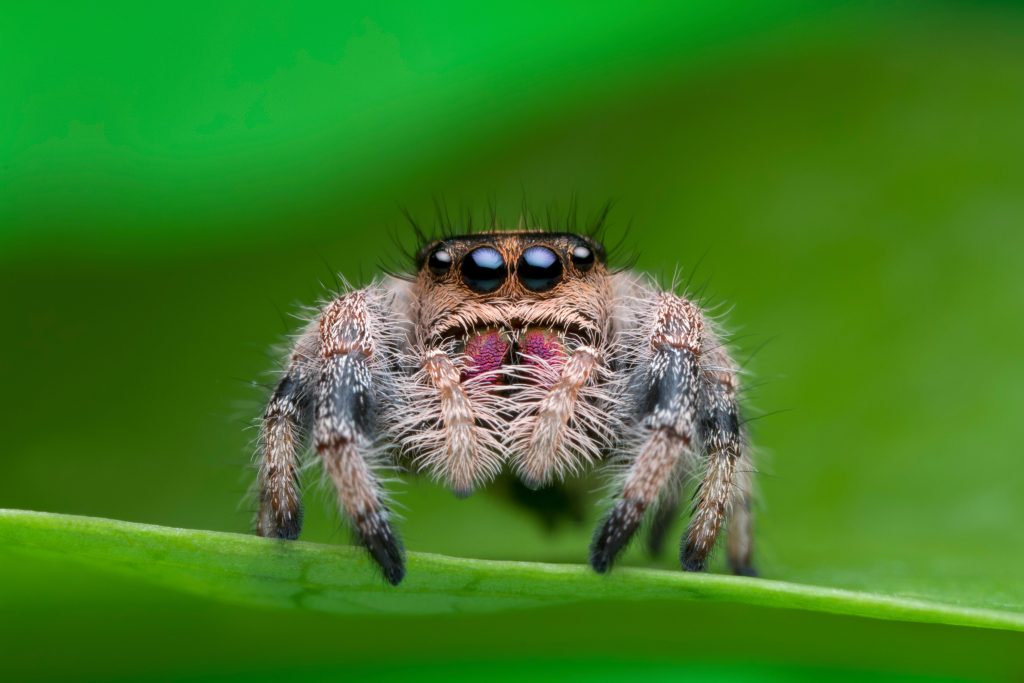
This unusual eye structure allows jumping spiders to detect movement around them while examining anything that catches their attention in detail.
Built to jump: How does it hunt without a web?
Unlike most web-building spiders, Phidippus regius captures its food through active hunting rather than using a prey-catching web. Thanks to its excellent eyesight, it can detect moving insects from a distance before approaching them cautiously. Once within striking range, it launches a rapid, precise leap towards its prey, seizing it with its powerful chelicerae.
The remarkable jumping movements of jumping spiders involve muscular action and rapid leg extension, in which hydraulic pressure can also play a role. These mechanisms allow the legs to extend quickly and the body to launch suddenly into the air. Research examining the jumps of Phidippus regius has also shown that the spider can adjust its movements according to the distance and direction of a jump, allowing it to reach its intended target efficiently.
Although it does not build a web for hunting, spider silk still plays an important role in its movement. Before jumping, the spider attaches a fine silk thread to a surface, which acts as a safety line. If it misses its jump or loses its grip, this thread can help prevent it from falling. This is particularly useful when moving among the branches and leaves of vegetation.
Inquisitive nature and complex behaviour
Phidippus regius often pauses, turns around and appears to examine its surroundings carefully. It responds quickly to moving objects and changes nearby, while also using its legs and pedipalps to sense the surfaces in front of it. This constant exploratory behaviour makes the species particularly fascinating to observe in a terrarium.
Visual signals also play an important role in communication within the species, particularly during courtship. When approaching females, males perform a characteristic courtship dance, raising and moving their legs while also using their posture and colouration to attract attention. These movements may help individuals recognise members of their own species and signal their intention to mate.
Alongside these striking movements, vibrations and touch may also play a role in communication. In certain situations, males may communicate with females through signals transmitted across a surface. The behaviour of Phidippus regiustherefore demonstrates how jumping spiders use several sources of information both to perceive their surroundings and to communicate with members of their own species.
Moulting and development: How does a jumping spider grow?
As Phidippus regius develops, not only its body size but also its colouration and markings can change considerably. This is particularly noticeable in females. Over time, their initially darker colouration may change to lighter shades of cream, orange or grey. Such variation can be especially striking in the ‘Bahamas’ form, although the final appearance differs between individuals.
As they reach sexual maturity, the differences between males and females also become more apparent. Males typically display distinctive black-and-white markings, while females show much greater variation in colour. The lifespan of adults may also differ between the sexes: females generally live longer than males, which often survive for a shorter period after their final moult.
Setting up a small terrarium
Despite its small size, Phidippus regius ‘Bahamas’ requires a carefully designed, well-ventilated terrarium with varied furnishings. An upright terrarium measuring approximately 15 × 15 × 25 cm may be suitable for an adult, while juveniles are best housed initially in smaller containers appropriate to their size.
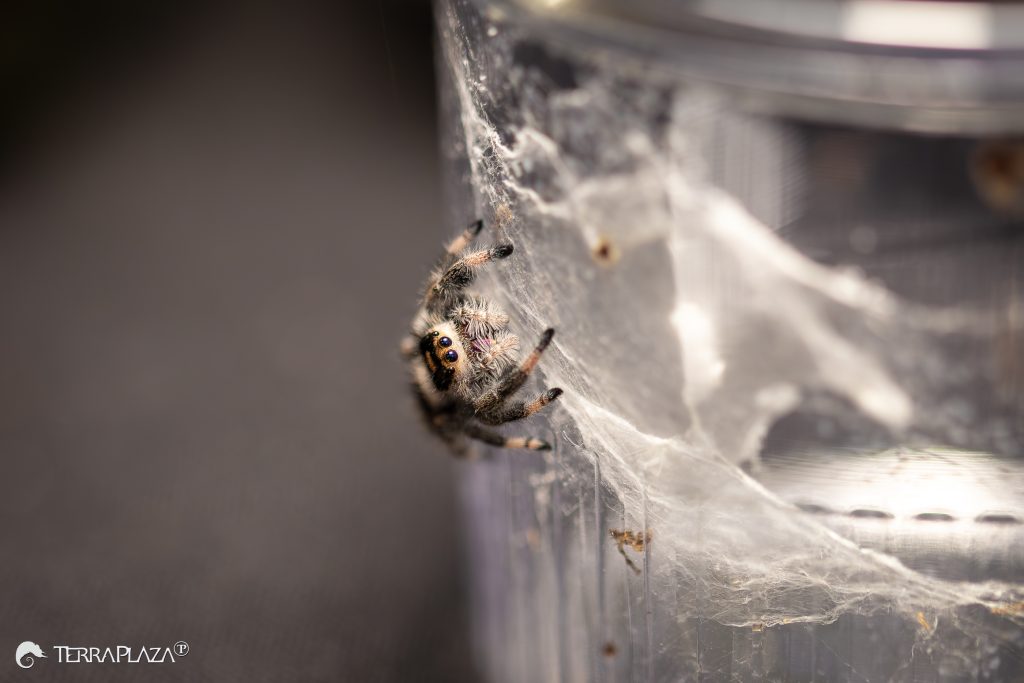
Because this species spends much of its time on elevated surfaces, furnishing the upper section of the terrarium is particularly important. Thin branches, pieces of cork bark and plants provide climbing opportunities, as well as suitable anchor points for the silken retreats the spiders construct for resting. A thin layer of coconut coir or another suitable terrarium substrate can be used on the floor. A side-opening or front-opening terrarium is preferable. This design reduces the risk of damaging silken retreats built near the top during routine care.
Suitable conditions and feeding
Temperature, humidity and lighting all play important roles when keeping Phidippus regius. As a general starting point, daytime temperatures of 22–28 °C and relative humidity of approximately 50–70% can be suitable for the species. Good cross-ventilation is particularly important, as persistently damp, stagnant air can encourage mould growth. The spider requires appropriate lighting during the day and a dark resting period at night, while overheating the terrarium must also be avoided.
Its diet consists of appropriately sized live insects, such as fruit flies, flies and small crickets. Juveniles feed more frequently, while adults feed less often. These spiders obtain much of their water from tiny droplets on terrarium walls or plants. Therefore, providing adequate hydration is essential. Individuals of Phidippus regius should be housed separately, as encounters between members of the same species can lead to cannibalism.
Handling: How friendly is a jumping spider?
Phidippus regius can tolerate contact with human hands relatively well, and thanks to its inquisitive nature, some individuals may voluntarily climb onto an outstretched hand. However, handling should always be based on the spider’s voluntary behaviour, and it should never be picked up by force.
During brief, calm interactions, particular care must be taken to prevent falls and unexpected jumps. It is therefore advisable to handle the spider at a low height and close to a soft surface. Handling should be avoided before, during and immediately after moulting. Some individuals readily climb onto an outstretched hand. However, regular handling is not necessary for their welfare.
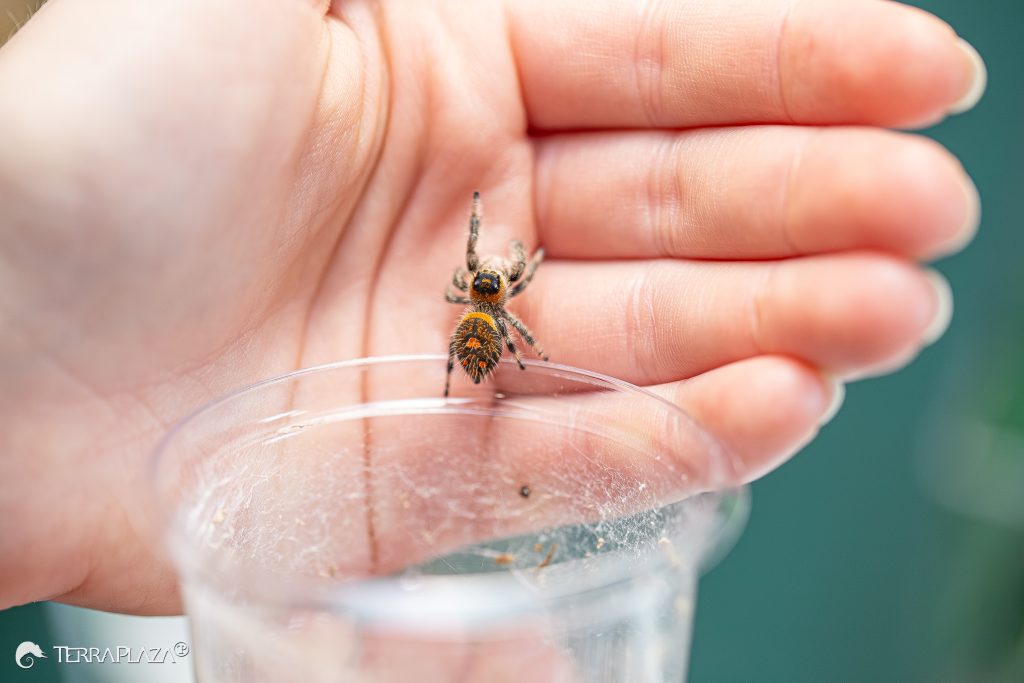
Despite its small size, Phidippus regius ‘Bahamas’ has remarkably complex senses and behaviour. It therefore demonstrates how sophisticated even a tiny predator can be. Its advanced vision, precise jumps, varied forms of communication and striking appearance make it a distinctive member of the jumping spider world. Its daytime activity and inquisitive, exploratory behaviour also make it fascinating to observe in a terrarium. Despite its small size, this predator displays a remarkable range of adaptations and complex behaviours.
